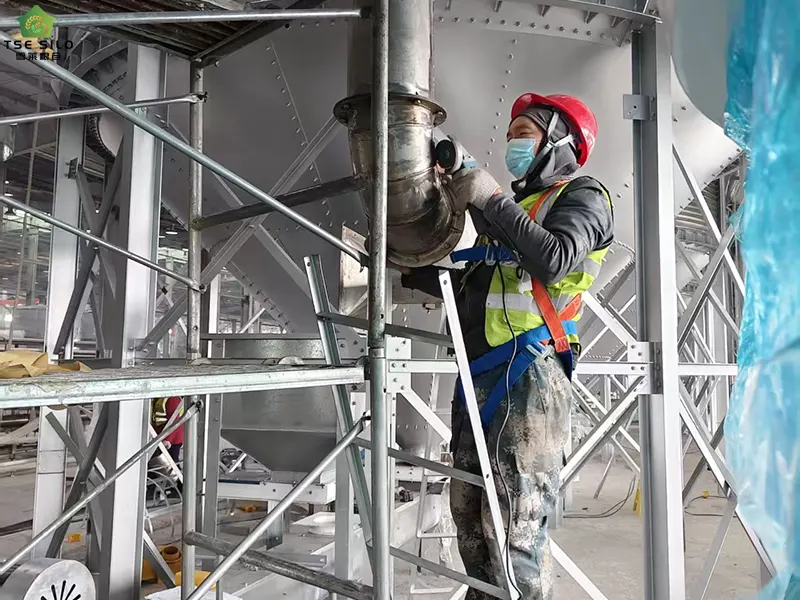
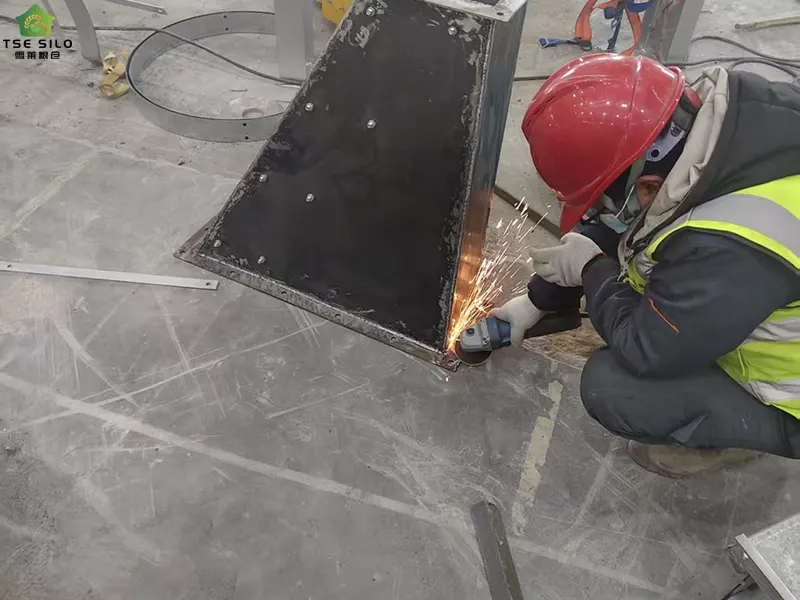
Welding is arguably one of the most crucial aspects of grain steel silos production and installation. As a steel silo manufacturer, Shelley Warehouse considers any substandard or improperly welded work to be unacceptable. We maintain strict standards for every weld, resolutely eliminating defects such as slag inclusions, bubbles, incomplete penetration, and lack of fusion. Below, we will explain the basic requirements for welds at steel silo sites.
1. Beveling and Cleaning Requirements
The welding quality requirements and processes for tack welds are the same as for permanent welds. Tack welds must be performed by welders with valid certifications.
- Basic Requirements: The bevel and both sides must be cleaned before welding.
- Content: Remove oil, rust, moisture, scale, and other impurities from the bevel surface. For plates requiring beveling, processing should be performed according to design requirements (e.g., gas cutting or machining) to ensure the bevel angle and blunt edge dimensions meet process requirements.
2. Misalignment Control at Joints
When beveling using gas cutting, the surface roughness of the bevel must not be lower than Grade I as specified in ZBJ59002.3-88.
- Basic Requirements: Strictly control the misalignment at the butt joint of steel plates.
- Content: The edges of adjacent plates should be aligned, and the misalignment should not exceed 10% of the plate thickness, and generally should not exceed 1.5mm (the specific requirement depends on the plate thickness; thinner plates have stricter requirements). Excessive misalignment will lead to stress concentration and affect weld strength.
3. Gap Uniformity
Welding bevels should generally meet the requirements specified in GB985 and GB986.
- Basic Requirements: Ensure the butt joint gap meets the welding process requirements.
- Content: The root gap reserved during assembly should be uniform (usually determined according to the plate thickness and welding method; for example, 2-3mm is common for manual welding) to ensure penetration and prevent burn-through.
4. Tack Welding Quality
For butt joints of weldments of the same thickness, the allowable misalignment in the weld seam of the butt joint should not exceed 1mm, and in the assembly weld seam, it should not exceed 2mm.
- Basic Requirements: Tack welds must be strong and have the same quality as the final weld seam.
- Content: The length, thickness, and spacing of tack welds should conform to the specifications (usually 30-50mm in length and 300-500mm in spacing). The start and end points of tack welds should have a smooth transition. If cracks, porosity, or other defects are found, they must be ground down and re-welded.
5. Environmental Adaptability Requirements
When the bevel gap is too large, it is not allowed to place reinforcing bars or steel plates in the bevel gap. When assembling weldments, if the bevel gap exceeds 5mm, but the length is ≤15% of the total weld length, surfacing is allowed. After surfacing, the weld bevel should be ground back to the original requirements.
- Basic Requirements: Protective measures should be taken in severe weather.
- Content: Welding is prohibited when any of the following conditions exist in the welding environment, and no effective protective measures are available: wind speed greater than 8 m/s (greater than 2 m/s for gas shielded welding); relative humidity greater than 90%; rain or snow; workpiece temperature below -20℃ (or the minimum welding temperature required for specific materials).
6. Selection and Storage of Welding Consumables
For welding joints requiring a backing plate, the backing plate should be firmly attached to the base metal surface, and the bevel should have an appropriate gap to ensure weld penetration.
- Basic Requirements: Welding consumables (electrodes, wires) must be compatible with the base metal and kept dry.
- Content: Strictly follow the design specifications for selecting the appropriate electrode type (e.g., electrodes compatible with Q235B or Q355B steel). Electrodes should be dried according to the instructions before use. Use an insulated container during welding and remove them only as needed. Welding consumables with peeling, deteriorated, or rusted coatings are strictly prohibited from use.
7. Welding Specification Parameter Execution
Before welding, water, oil, rust, and other contaminants must be thoroughly cleaned from the bevel.
- Basic Requirements: Strictly adhere to the established welding process parameters.
- Content: Control the welding current, arc voltage, welding speed, and interpass temperature. Unnecessary increases in current are strictly prohibited to avoid undercut or burn-through. For multi-layer, multi-pass welding, the interpass temperature should be controlled, and the slag from the previous layer should be cleaned before proceeding to the next pass.
8. Weld Appearance and Formation
Setting of welding backing plates, arc-starting plates, and arc-exiting plates.
- Basic Requirements: The weld surface should be aesthetically pleasing and dense.
- Content: The weld reinforcement and width should be uniform and consistent, with a smooth transition. The weld surface must be free of defects such as cracks, lack of fusion, slag inclusions, porosity, and weld beads. For grain steel silos, it is particularly important that internal welds be as smooth as possible to reduce grain accumulation and dust buildup.
9. Undercut and Crater Treatment
Tack welds should have sufficient strength, but their thickness should generally not exceed half the thickness of the permanent weld, typically 4-6 mm. The length of tack welds is generally 30-60 mm, and the spacing should preferably not exceed 400 mm.
- Basic Requirements: Strictly control the depth of undercut and fill the crater completely.
- Content: Undercut is a stress concentration source; its depth should not exceed 0.5 mm (stricter requirements may be needed for critical areas such as circumferential welds), and the cumulative length must not exceed the limit. The crater must be filled completely when the weld is finished to prevent crater cracking.
10. Post-Weld Cleaning and Marking
Welding electrodes and fluxes must be dried according to the instructions. After drying, electrodes and fluxes should be stored in a constant temperature chamber at 100-150℃. Welders should place them in an insulated container during welding and use them only as needed.
- Basic Requirements: Post-weld cleaning and marking are mandatory.
- Content: Remove slag and spatter from the weld surface. According to drawings or specifications, welder stamps or markings should be affixed to designated locations for quality traceability. For welds requiring grinding (such as the inner wall of the silo), the weld excess height must be ground flush with the base material as per design requirements.
Conclusion:
Welding of grain steel silos must ensure not only strength but also airtightness (insect and moisture prevention). Therefore, the requirements for weld joints are more stringent than for ordinary steel structures, paying particular attention to pre-weld cleaning, protection during welding, and post-weld visual inspection. If subsequent kerosene leakage or vacuum chamber tests are required, the weld quality must meet standards beforehand. These are the ten basic requirements for weld joints from grain steel silos manufacturers. We would like to emphasize that at Shelley Machinery, we generally use radiographic testing to detect potential problems in major load-bearing welds, and visual inspection for ordinary welds to ensure the steel silo project is flawless.
Written by
Shandong Shelley Grain Steel Silo Co., Ltd
Editor Jin
WhatsApp : +86-18653877118
Email : shelley@cnshelley.com