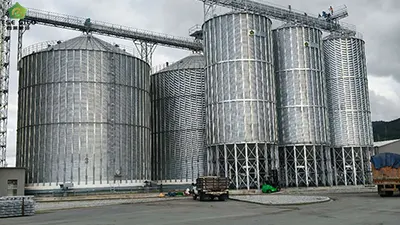
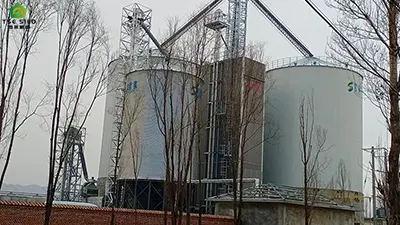
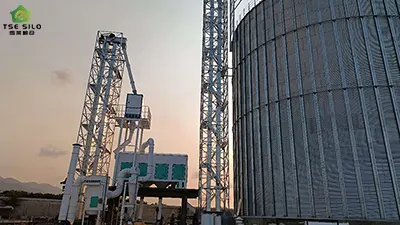
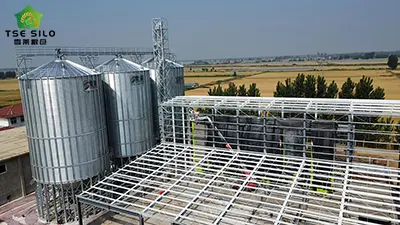
In grain storage systems, Shelley grain steel silos are widely used due to their advantages such as short construction period, good airtightness, and high degree of mechanization. Grain feeding, as the "first mile" of the storage process, directly affects grain breakage rate, cleaning efficiency, and subsequent storage safety. This article will review six mainstream steel silo grain feeding processes currently used in the industry.
1. Bucket Elevator Feeding (Most Commonly Used)
- Principle: After unloading in the pit and cleaning equipment, grain is vertically conveyed to the top of the silo by a bucket elevator, and then fed into the silo via chutes/distributors.
- Features: High vertical conveying efficiency, small footprint, moderate cost; suitable for single silos/silo groups, and mainstream grains such as wheat, corn, and rice; requires horizontal conveying on the silo top (scraper/belt conveyor).
- Applicable to: Conventional steel silos, shallow circular silos, and vertical silos, with a daily processing capacity of 50–500 tons.
2. Scraper Conveyor for Silo Entry (Horizontal Conveying from Silo Top/Bottom)
- Principle: A scraper conveyor is installed on the silo top to receive grain from the elevator, unloading it at multiple points along the silo top track into the silo; it can also be used for horizontal grain collection below the silo.
- Features: Stable horizontal conveying, multi-point material distribution, prevents grading; good sealing, low dust; however, higher energy consumption and slightly more complex maintenance.
- Applications: Large steel silo complexes, multiple silos sharing a single conveyor line, scenarios requiring uniform material distribution.
3. Belt Conveyor for Silo Entry (Long Distance/High Flow Rate)
- Principle: Belt conveyors transport grain horizontally/inclined, in conjunction with elevators, to the silo top for entry.
- Features: Long conveying distance, high flow rate, low breakage rate; suitable for long-distance transfer; however, large footprint, open design prone to dust generation.
- Applications: Grain depots/ports/processing plants, long-distance, high-flow grain entry.
4. Pneumatic Pipeline Entry (Low Breakage/Flexible Layout)
- Principle: A blower generates negative/positive pressure, suspending the grain within the pipeline and conveying it to the top of the silo, where it is unloaded into the silo via a separator.
- Features: Flexible pipeline layout, allows for multiple entry points, extremely low breakage rate; suitable for fragile grains (soybeans/rice/malt); however, it has high energy consumption and is sensitive to moisture and impurities.
- Applications: High-quality grains, complex silo layouts, and scenarios requiring low breakage.
5. Screw Conveyor Entry (Short Distance/Low Flow)
- Principle: The screw conveyor conveys horizontally/inclinedly, directly feeding grain into the silo opening or elevator inlet.
- Features: Simple structure, small footprint, low cost; suitable for short distances and low flow rates; however, it is prone to breakage and not suitable for long distances/high flow rates.
- Applications: Small steel silos, auxiliary conveying, and mobile equipment integration.
6. Mobile Equipment for Warehousing (Flexible/Emergency)
- Principle: Utilizing a combination of mobile elevators, mobile conveyor belts, and grain suction machines, it flexibly connects to the unloading point and warehouse opening for grain entry.
- Features: No fixed civil engineering required; highly mobile; rapid deployment; suitable for temporary grain collection and emergency replenishment; efficiency is lower than fixed equipment.
- Applications: Small warehouses, seasonal grain collection, old warehouse renovation, emergency operations.
7. Comparison of Grain Storage Methods (Core Indicators)
| Storage Method |
Conveying Efficiency |
Grain Breakage Rate |
Layout Flexibility |
Applicable Scenarios |
Typical Silo Types |
| Bucket Elevator |
★★★★☆ |
Medium |
Medium |
Conventional Grain Storage, Mainstream Grain Types |
Steel Silo, Vertical Silo |
| Scraper Conveyor |
★★★☆☆ |
Medium-Low |
Medium-High |
Silo Cluster, Multi-Point Distribution |
Large Steel Silo Cluster |
| Belt Conveyor |
★★★★★ |
Low |
Medium |
Long Distance, High Flow |
Grain Depot, Port |
| Pneumatic Pipeline |
★★★☆☆ |
Very Low |
Very High |
High Quality, Fragile Grain |
Special Grain Steel Silo |
| Screw Conveyor |
★★☆☆☆ |
Medium-High |
Low |
Short Distance, Low Flow |
Small Steel Silo |
| Mobile Equipment |
★★☆☆☆ |
Medium |
Very High |
Temporary, Emergency, Small Silo |
Small/Temporary Silo |
8. General Silo Entry Process (All Methods Pre-processed)
- 8.1. Sampling Inspection: Test for moisture, impurities, color, and odor; reject or process unqualified samples.
- 8.2. Weighing: Gross weight → unloading → tare weight; calculate and record net weight.
- 8.3. Initial Impurity Removal: Cleaning sieve + magnetic separation to remove large/small impurities/metals, ensuring the purity of the grain entering the silo.
- 8.4. Silo Placement: Use the above method for silo placement, ensuring even distribution, controlling drop height, and minimizing breakage and grading.
- 8.5. Process Monitoring: Randomly inspect quality and observe grain condition during silo entry.
- 8.6. Safe Operation: Fire prevention, explosion prevention, dust prevention, and standardized equipment operation.
9. Summary and Recommendations
When selecting a specific grain receiving process, the following three dimensions should generally be considered:
- 9.1. Grain Quality: For seed grains or grains sensitive to breakage such as corn and soybeans, low-breakage processes (such as belt conveyors) should be prioritized, avoiding the use of pneumatic conveyors and high-throw equipment.
- 9.2. Operational Scale: Belt conveyors are preferred for high throughput, scraper conveyors for strict dust control, and mobile conveyors for flexible grain replenishment.
- 9.3. Automation Level: Modern intelligent grain depots tend to combine the fifth method (distributor) with the first method (belt conveyor) to achieve unmanned operation.
Grain receiving operations in steel silos are the "first line of defense" for grain storage, and the rationality of the selected process directly determines the efficiency and safety of subsequent storage operations. From efficient traditional belt conveyor transport to flexible and energy-saving elevated gravity flow, these six mainstream processes each have their advantages and disadvantages, and there is no absolute superiority or inferiority. The key is whether they match the scale of the grain depot, the grain variety, and the investment budget.
In practical applications, we should not only focus on the selection and layout of grain steel silos, but also emphasize the innovation of process combinations and the refinement of details—reducing grain breakage, minimizing dust, and saving electricity are all micro-level practices of the "storing grain through technology" strategy. With the development of intelligent and green grain storage technologies, future grain receiving systems will inevitably evolve towards greater flexibility, energy efficiency, and intelligence, providing solid technical support for safeguarding the nation's grain reserves.
Written by
Shandong Shelley Grain Steel Silo Co., Ltd
Editor Jin
WhatsApp : +86-18653877118
Email : shelley@cnshelley.com