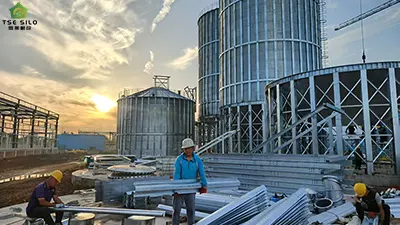
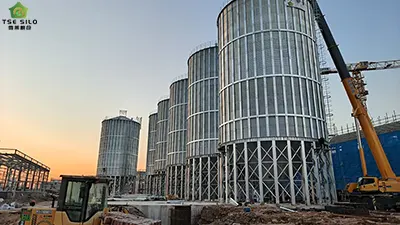
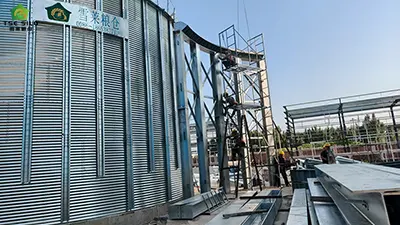
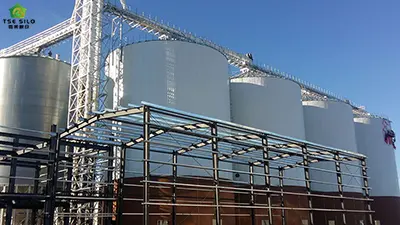
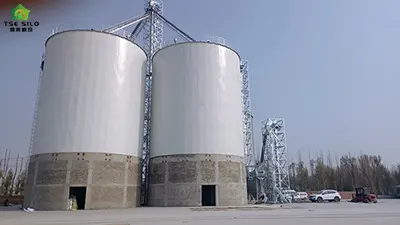
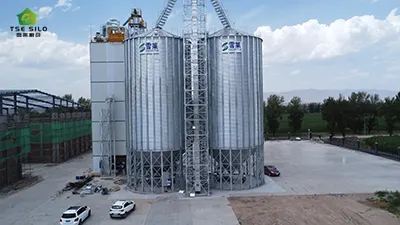
The high-efficiency vibrating screen is a core pre-processing equipment in grain steel silo systems, primarily used for cleaning and grading grain before it enters the silo. By removing impurities such as straw, stones, and dust, it reduces the risk of mold and insect infestation, ensuring storage safety and improving the efficiency of subsequent drying, conveying, and processing stages. It acts as a "gatekeeper" in the steel silo system and is one of the key pieces of equipment for achieving standardized grain storage.
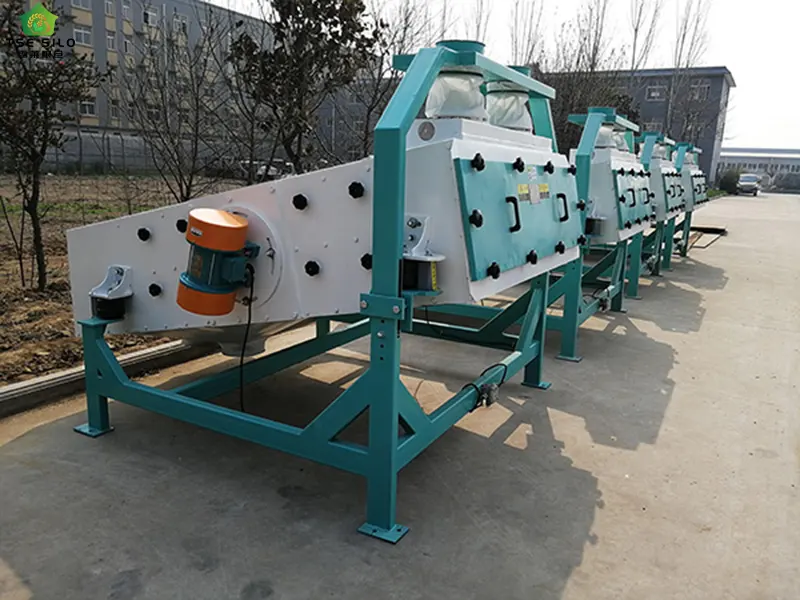
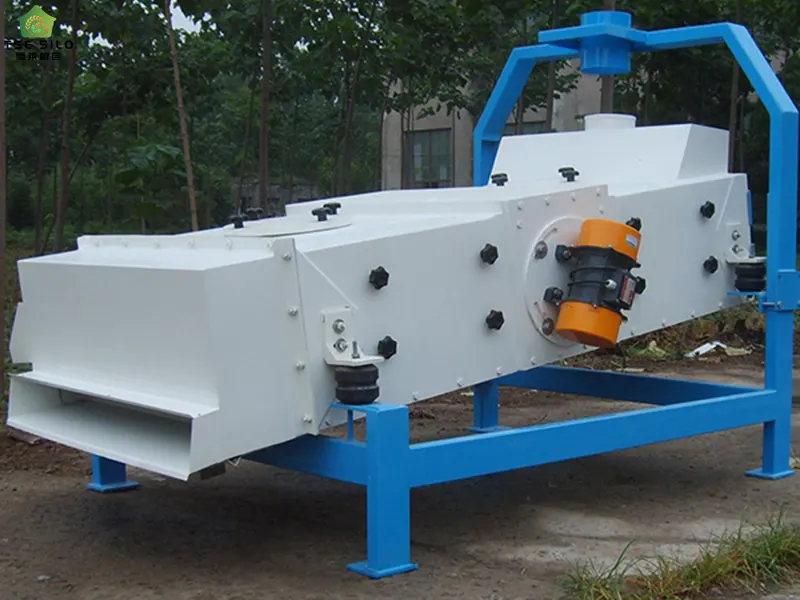
1. Core Working Principle
The high-efficiency vibrating screen is based on the principle of "vibration excitation + screen surface grading." Mechanical vibration causes the material to move in a high-frequency, regular motion on the screen surface. The difference in size between the screen mesh and the material particles is used to separate the material from impurities. The specific process is as follows:
1.1. Vibration Source Drive (Power Core)
The core power of the equipment comes from dual vibrating motors (or exciters), usually symmetrically installed on both sides of the screen body. When the motors rotate synchronously in opposite directions, they generate high-frequency inertial excitation force (amplitude adjustable, generally 3-8mm, frequency 15-50Hz), driving the screen body to perform linear or elliptical vibration (selected according to process requirements).
- Linear vibration: The material is thrown forward in a straight line along the screen surface, suitable for coarse screening and rapid impurity removal.
- Elliptical vibration: The material moves in an elliptical trajectory on the screen surface, combining forward propulsion and up-and-down tumbling effects, resulting in more thorough screening, suitable for fine grading.
1.2. Material Movement and Screening Process
- 1.2.1. Grains (such as wheat, corn, and rice) enter the screen surface through the feed inlet. Under vibration excitation, the material layer is loosened and thrown up, forming a "fluidized state," preventing material from clogging the screen holes.
- 1.2.2. Grain particles that meet the screen mesh size (e.g., corn kernels with a diameter of approximately 5-8mm, corresponding to a screen mesh size of 4-6mm) pass through the screen holes and fall into the lower discharge channel, entering the subsequent elevator or directly into the silo.
- 1.2.3. Impurities larger than the screen holes (such as straw, large stones, and clusters of shriveled grains) are intercepted by the screen surface and move along the inclined direction of the screen surface (the screen surface inclination angle is generally 5-15°, adjustable) towards the impurity discharge port, and are finally discharged from the equipment.
- 1.2.4. If multi-stage screening is required (e.g., for graded storage of grains of different particle sizes), the equipment can be equipped with multiple layers of screens (2-3 layers). The upper coarse screen removes large impurities, the middle fine screen performs grading, and the lower layer collects dust, achieving "one-time feeding, multiple processing."
1.3. Key Logic of High-Efficiency Screening
- High-frequency vibration reduces the adhesion between the material and the screen, improving screening efficiency (more than 30% higher than ordinary vibrating screens).
- The inclined screen surface design, combined with the vibration direction, controls the residence time of the material on the screen surface (10-30 seconds), ensuring sufficient separation of impurities.
- The mesh size of the grading screen can be customized according to the type of grain (e.g., wheat screen mesh size 3.5-4.5mm, rice 4.0-5.0mm), adapting to different storage needs.
2. Core Role in Steel Silo Systems
2.1. Impurity Removal, Ensuring Storage Safety
Impurities such as straw, stones, and dust in the grain can lead to:
- 2.1.1 Poor ventilation during storage, causing localized increases in temperature and humidity, leading to mold.
- 2.1.2 Impurities carrying insect eggs, increasing the risk of insect infestation.
- 2.1.3 Clogging of the steel silo's feed inlet, ventilation pipes, or discharge device. The high-efficiency vibrating screen can remove more than 85% of large impurities and more than 60% of dust, bringing the grain purity up to storage standards (generally requiring impurity content ≤ 1.0%).
2.2. Grain Grading, Enhancing Storage Value
By replacing screens with different mesh sizes, grains can be graded according to particle size (e.g., corn can be divided into large, medium, and small grades). Graded grains have higher uniformity, resulting in more even ventilation and drying during storage, reducing problems of localized excessive moisture; at the same time, graded grains can meet different processing needs (e.g., large corn kernels for feed, small kernels for brewing), increasing product added value.
2.3. Protecting Downstream Equipment and Reducing Operation and Maintenance Costs
If impurities directly enter the steel silo or supporting equipment (such as screw conveyors, bucket elevators, and dryers), it may lead to:
- 2.3.1 conveyor jamming and motor overload and burnout.
- 2.3.2 dryer heat exchanger tube blockage and reduced thermal efficiency.
- 2.3.3 arching at the steel silo discharge port. The vibrating screen removes impurities in advance, extending the service life of downstream equipment and reducing downtime due to malfunctions.
3. Key Technical Features (Differences from Ordinary Vibrating Screens)
3.1. High Efficiency
- Large processing capacity: The processing capacity of a single unit can reach 50-500 t/h (depending on the model), suitable for the continuous loading requirements of large steel silos (10,000 tons and above).
- High screening rate: Using a "high-frequency, low-amplitude" vibration design, the screening rate is 20-40% higher than ordinary vibrating screens, resulting in less impurity residue.
- Precise grading: Multi-layer screens (2-3 layers) can achieve integrated "impurity removal + grading" without additional equipment.
3.2. Strong Adaptability (Optimized for Steel Silo Systems)
- Compact Structure: Adopting a modular design, it occupies a small footprint and can be directly installed in front of the steel silo's inlet (in series with the elevator and cleaning machine), adapting to the spatial layout of the steel silo system.
- Inlet/Outlet Connection: The inlet can be connected to the discharge end of the bucket elevator, and the outlet is directly connected to the steel silo's feeding pipe through a chute, reducing material spillage during transfer.
- Dustproof Design: Equipped with a sealed screen body and dust removal interface, it can be linked with the dust removal equipment of the steel silo system to prevent dust diffusion during the screening process, meeting environmental protection requirements.
3.3. Stability and Easy Maintenance
- Wear-Resistant Design: The screen mesh is made of high-manganese steel and stainless steel (selected according to the corrosiveness of the grain), and the surface is treated for wear resistance, ensuring a long service life; the screen surface can be quickly disassembled and replaced to adapt to different types of grain.
- Vibration Reduction and Noise Reduction: The bottom of the screen body is equipped with rubber shock-absorbing springs, reducing the impact of vibration on the steel silo foundation, and the operating noise is ≤85dB(A), meeting industrial noise standards.
- Intelligent Control: It can be equipped with a variable frequency speed control motor to adjust the vibration frequency and processing capacity according to the impurity content and humidity of the grain entering the silo, and it can be linked with the PLC control system of the steel silo system to achieve automated operation.
3.4. Multifunctional Adaptability
- Adaptable to various grains: Wheat, corn, rice, soybeans, etc., can all be processed by simply changing the screen mesh.
- Integrated auxiliary functions: Some models can integrate magnetic separation devices (to remove iron impurities from the grain and protect subsequent processing equipment) and airflow adjustment devices (to assist in removing light impurities such as wheat husks and dust).
4. Main Technical Parameters (Key Selection Criteria)
| Parameter Type | Common Range | Selection Basis |
| Processing Capacity | 50-500 t/h | Daily silo input volume and input speed |
| Number of Sieve Layers | 1-3 layers | Screening requirements (1-2 layers for impurity removal only, 3 layers for grading) |
| Sieve Mesh Size | 1.0-10mm (customizable) | Grain type (e.g., rice 4.0-5.0mm, wheat 3.5-4.5mm) |
| Vibration Frequency | 15-50Hz | Material characteristics (low frequency and high amplitude for wet grain, high frequency and low amplitude for dry grain) |
| Amplitude | 3-8mm | Impurity content (larger amplitude for higher impurity content) |
| Sieve Surface Angle | 5-15° (adjustable) | Material fluidity (larger angle for poor fluidity) |
| Motor Power | 1.5-15kW | Processing capacity, sieve body weight |
| Overall Dimensions (L×W×H) | 2.5-6m×1.2-2.5m×1.8-3.5m | Installation space of the steel silo system |
5. Matching Design with Steel Silo System
5.1. Installation Location
- It is usually installed at the front end of the steel silo feeding system, in series with the process of "elevator → vibrating screen → steel silo inlet". Some large steel silo systems will have a "pre-cleaning + fine cleaning" two-stage vibrating screen to ensure thorough impurity removal.
5.2. Interlocking Control
- Interlocking with the elevator: The conveying speed of the elevator is matched with the processing capacity of the vibrating screen to prevent material accumulation or interruption of material flow.
- Interlocking with the dust removal system: The dust removal interface of the vibrating screen is connected to the pulse dust collector of the steel silo system to process the dust generated during the screening process in real time.
- Interlocking with the PLC system: Sensors detect the material thickness and impurity content on the screen surface, automatically adjusting the vibration frequency or triggering a shutdown alarm (e.g., when the screen is blocked).
5.3. Adaptation to Special Scenarios
- High-temperature and high-humidity environments: Waterproof motors and corrosion-resistant screens are used, suitable for humid areas in southern regions or for screening hot grains after drying.
- Large steel silo clusters: Multiple vibrating screens are operated in parallel to meet the continuous silo loading requirements of tens of thousands of tons of silo clusters.
- Mobile operation: Optional wheeled base is available, suitable for temporary storage points or scenarios where multiple steel silos share one device.
6. Maintenance Points and Common Fault Handling
6.1. Routine Maintenance
- Regularly check the screen tension (to avoid reduced screening efficiency due to looseness), and replace worn or damaged screens.
- Clean residual materials from the screen surface and screen holes to prevent mold and clumping.
- Check the fixing bolts of the vibration motor and the bearing temperature (normal temperature ≤75℃), and regularly add lubricating oil.
- Check the elasticity of the shock-absorbing springs to prevent unstable vibration due to spring aging.
6.2. Common Faults and Troubleshooting
| Fault Type | Cause Analysis | Solution |
| Low Screening Efficiency | Incorrect screen mesh size, low vibration frequency, small screen inclination angle | Replace with appropriate screen mesh, increase vibration frequency, increase screen inclination angle |
| Screen Clogging | High material moisture, small screen holes, small vibration amplitude | Dry the material before screening, replace with larger mesh screen, increase vibration amplitude |
| Abnormal Equipment Vibration | Motor phase error, damaged damping springs, loose bolts | Adjust motor phase, replace damping springs, tighten bolts |
| Excessive Noise | Bearing wear, screen and sieve body collision, aging springs | Replace bearings, adjust screen position, replace springs |
| Excessive Impurities in Output | Damaged screen, impurities not removed promptly, excessive material layer thickness | Repair or replace the screen, clean the impurity discharge port, reduce feeding speed |
7. Summary of Application Value
High-efficiency vibrating screens are key equipment for "improving quality, increasing efficiency, and ensuring safety" in steel silo systems:
- 7.1. Improving grain storage quality: Reducing mold and insect infestation caused by impurities, extending grain storage life (e.g., corn storage can be extended by 6-12 months).
- 7.2. Reducing system operating costs: Protecting subsequent equipment, reducing maintenance costs, and improving ventilation and drying efficiency (saving 10-20% energy).
- 7.3. Meeting standardized storage requirements: Complying with national grain storage standards (GB/T 29890-2013 "Grain and Oil Storage Management Measures"), providing quality assurance for grain acquisition, processing, and sales.
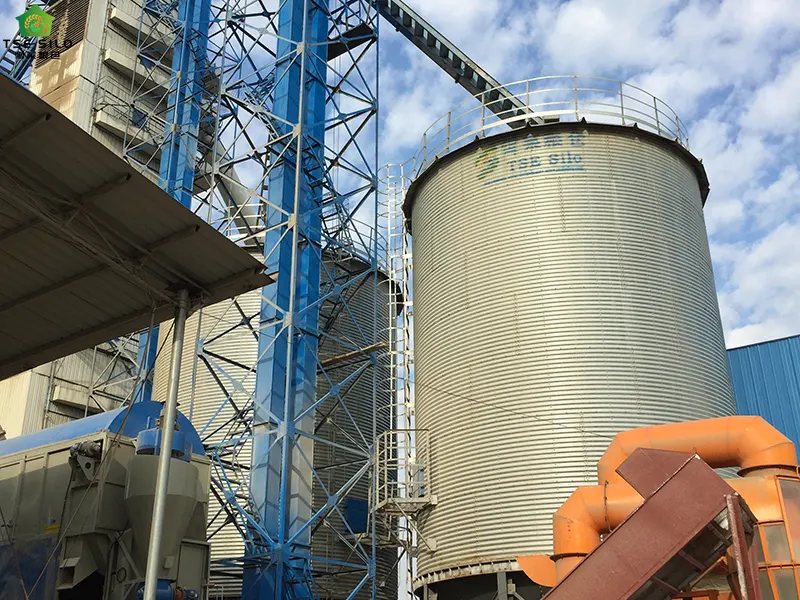
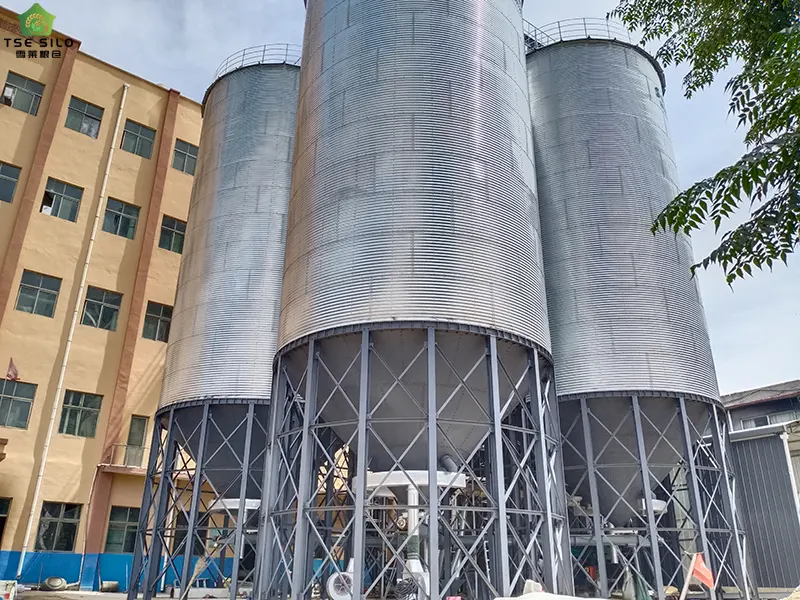
High-efficiency vibrating screens are indispensable process optimization and safety protection equipment in steel silo systems. As steel silos develop towards larger scale and intelligence, high-efficiency vibrating screens are also continuously upgraded, integrating functions such as intelligent monitoring (screen wear detection, online impurity content monitoring) and Internet of Things control (remote parameter adjustment, fault early warning) to further meet the needs of modern grain storage systems. Through its ingenious vibration mechanics design, it efficiently solves the problems of screening, impurity removal, and arching in bulk material handling, ensuring smooth material flow, stable equipment operation, and the quality of the final product. It is a crucial component in achieving automation, cleanliness, and efficiency in bulk material storage systems. Its integration with steel silos embodies the advanced concept of integrated "storage" and "fine processing" in modern industrial material handling.
Written by
Shandong Shelley Grain Steel Silo Co., Ltd
Editor Jin
WhatsApp : +86-18653877118
Email : shelley@cnshelley.com