Choosing the right grain storage solution is one of the most critical decisions for any farming operation, grain processing facility, or agricultural business. The choice between steel silos and concrete silos directly affects storage efficiency, operating costs, maintenance requirements, and long-term performance. Both options have been widely used in the industry, but each serves different operational needs, environments, and budgets.
This comprehensive comparison will help you determine which storage solution best fits your specific requirements.
What Are Steel Silos?
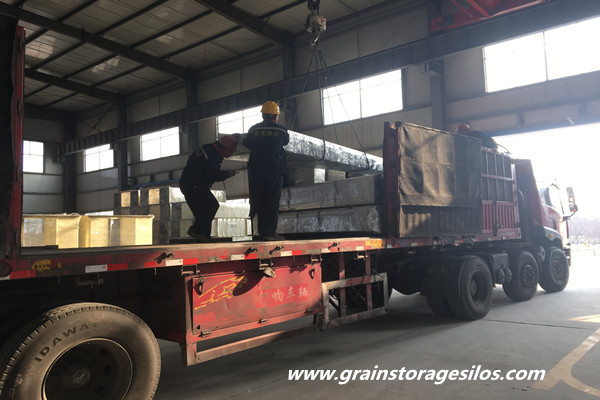
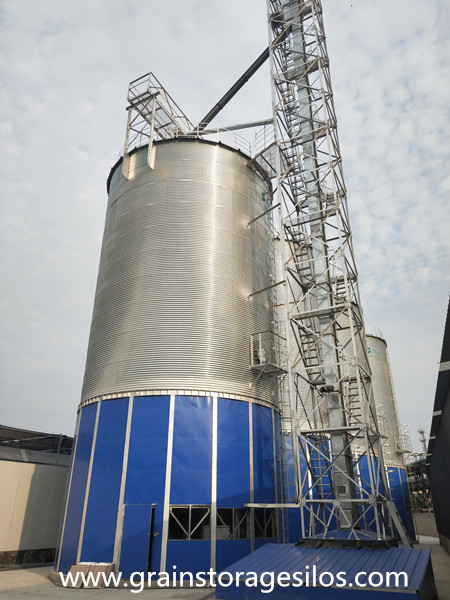
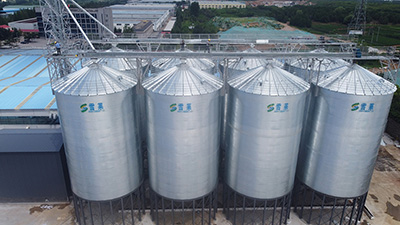
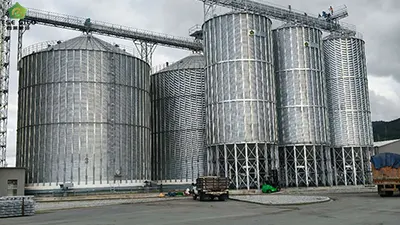
Steel silos are prefabricated storage structures made of high-strength galvanized or coated steel. Components are manufactured in controlled factory conditions to maintain quality and precise tolerances, then assembled on site. The modular design allows for expansion, modification, or even relocation as storage needs change.
- Common applications: Steel silos are widely used for grain, feed, cement, fertilizer, and other bulk materials in agricultural and industrial facilities. They are particularly suited for operations that require quick installation and the flexibility to expand capacity in the future.
- Types of steel silos: The two most common types are spiral steel silos and bolted steel silos. Spiral silos are made by continuously spirally rolling galvanized steel sheets, creating a seamless structure with excellent sealing. Bolted silos use prefabricated steel plates assembled on-site with bolts, supporting ultra-large capacities up to 10,000 tons per silo.
What Are Concrete Silos?
Concrete silos are built directly on site using reinforced concrete, typically employing slip-form or cast-in-place construction methods. Their performance depends heavily on weather conditions, concrete quality, curing time, and construction accuracy. Once built, concrete silos become permanent structures that are difficult and costly to modify or relocate.
- Common applications: Concrete silos are commonly used for large-capacity and long-term storage, including cement, coal, fly ash, aggregates, and high-volume grain storage. They are often selected for heavy industrial environments where maximum rigidity and mass are required.
Head-to-Head Comparison
1. Cost: Initial Investment and Long-Term Value
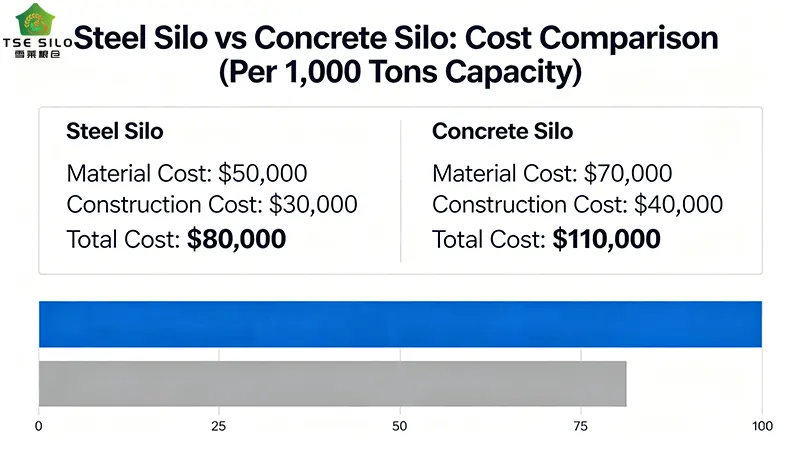
Steel Silos: For the same storage capacity, the initial construction cost of steel silos is generally lower than that of concrete silos. A steel silo typically costs in the range of US $25–45 per ton of capacity, while a concrete silo tends to cost US $50–100 per ton for comparable capacity.
Taking a 1,000-ton silo as an example:
- Steel silo material cost: $23,000–$28,000
- Concrete silo material cost: $38,000–$46,000
Beyond material costs, steel silos offer significant savings in:
- Construction labor: Steel silo labor costs $5,000–$8,000 vs. $12,000–$18,000 for concrete
- Transportation: Steel silo freight $3,000–$5,000 vs. $8,000–$11,000 for concrete
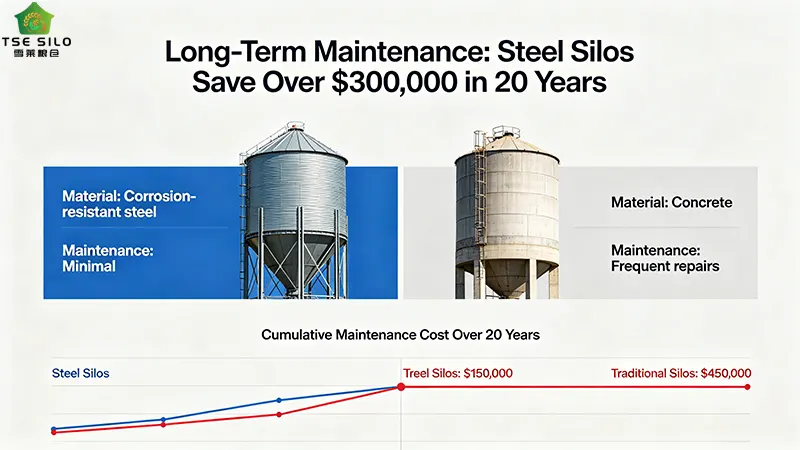
- Annual maintenance: Steel silos require $0 maintenance in the first 20 years (with hot-dip galvanization) vs. $1,200–$2,300/year for concrete silos
While concrete silos can appear cheaper initially in some cases, steel silos often deliver better cost-efficiency over the silo’s lifetime. The factory fabrication of steel reduces on-site labor, construction delays, and the risk of material loss.
2. Construction Speed and Timeline
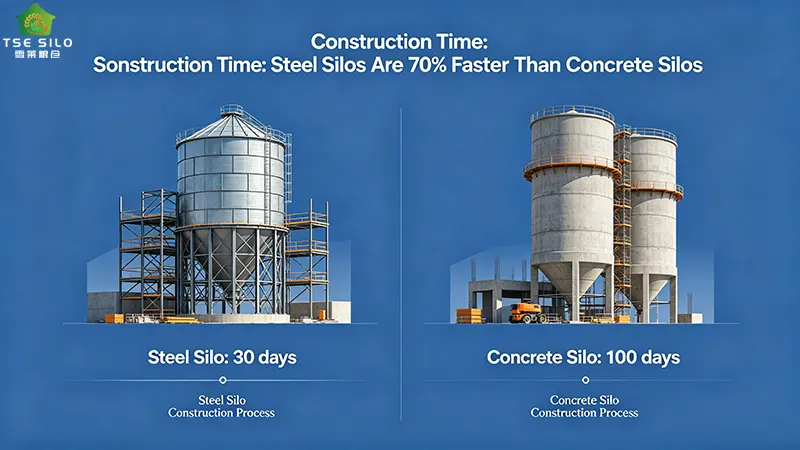
- Steel Silos: Steel silos are manufactured using standardized factory-produced components, then transported to the site for assembly—a construction method akin to “building blocks”. A 10,000-ton silo can be structurally completed within weeks. A 1,000-ton spiral silo can be built in just 5–6 days. In comparison to concrete, the construction period of steel silos is typically only 1/3 to 1/2 that of concrete silos of the same capacity.
- Concrete Silos: Concrete silo construction involves wet work with cumbersome procedures—formwork erection, steel bar binding, pouring, and curing. The process is highly susceptible to weather conditions such as low temperatures, rain, and snow. A large concrete silo typically takes 10–14 months to complete. This longer timeline means delayed commissioning and slower revenue generation.
- Verdict: Steel silos offer a clear advantage in construction speed—often 70% faster than concrete alternatives.
3. Foundation and Site Requirements
- Steel Silos: Steel silos are significantly lighter than concrete silos of the same size, which greatly reduces the load-bearing capacity and requirements of the foundation. On soft soil foundations with poor geological conditions, this can save considerable costs and time in foundation treatment. Steel silos can be mounted where soil quality is not optimal, offering greater flexibility for farms and industrial sites where soil strength is limited.
- Concrete Silos: Concrete silos require high-load-bearing soil to support their immense weight. The heavy structural deadweight imposes extremely high requirements on foundation bearing capacity. This limits site selection and significantly increases groundwork costs.
- Verdict: Steel silos are far more adaptable to various site conditions and can save substantial foundation costs, especially in areas with poor soil.
4. Grain Quality and Storage Performance
Steel Silos: Steel silos offer excellent airtightness—one of their core technological advantages. Steel plates can be rolled into an extremely dense structure, and with proper sealant application, the airtightness far surpasses that of concrete structures with tiny gaps and pores. This superior sealing enables:
- Effective low-temperature storage that retains cold air for long-term, efficient grain preservation
- Controlled atmosphere storage using nitrogen or CO₂ for insecticidal and antibacterial effects
- Superior moisture prevention to isolate external humid air and prevent grain from becoming damp and moldy
Studies have shown that steel silos demonstrate better overall ventilation performance across all product types and are approximately twice as efficient as reinforced concrete silos in terms of thermal performance. For cereals with high respiration rates like maize, steel silos with more effective ventilation are considered a more suitable solution.
Concrete Silos: While concrete provides good thermal insulation properties that help maintain stable internal temperatures, the material has inherent limitations:
- Concrete has low tensile strength and is prone to cracking
- The rough inner wall is prone to material adhesion and may wear and peel after long-term use
- Poor structural flexibility makes concrete silos vulnerable to harmful cracks when uneven foundation settlement occurs
- Verdict: Steel silos provide superior grain preservation through better airtightness, ventilation efficiency, and smoother interior surfaces.
5. Maintenance and Lifespan
Steel Silos: With hot-dip galvanized coating (275g/m² standard), steel silos enjoy ultra-long anti-corrosion protection. The galvanized layer provides significant corrosion resistance with a service life of more than 30 years. The smooth inner wall has a low coefficient of friction, facilitating grain flow and preventing material adhesion and scaling. Steel silos require minimal maintenance—in fact, the first 20 years typically require zero maintenance costs.
Concrete Silos: Concrete silos have a potential lifespan of up to 50 years, but this comes with significant caveats:
- Concrete requires regular repairs to address cracking, spalling, and rebar corrosion
- Annual maintenance costs range from $1,200 to $2,300 per year
- Rough interior surfaces require more frequent cleaning and may affect grain quality over time
6. Flexibility, Expansion, and Relocation
- Steel Silos: Steel structures are easy to modify, expand, or dismantle as needed. If future needs require increased storage capacity or changes to the process flow, steel silos are relatively easy to modify and connect. In some cases, the entire steel silo can be disassembled, moved to a new site, and reinstalled—offering tremendous flexibility. Steel silos also have high residual value when relocated.
- Concrete Silos: Once built, concrete silos are permanent fixed structures that cannot be relocated, are difficult to expand, and have high disposal costs after being abandoned. Modification costs for concrete silos are substantially higher—relocation or renovation costs $15,000–$23,000 for concrete vs. only $3,000–$6,000 for steel.
- Verdict: Steel silos offer unmatched flexibility for growing operations and changing business needs.
7. Seismic Performance
- Steel Silos: Steel has high strength in both tensile and compressive strength, enabling thin-walled structures with good structural toughness. The lighter weight and flexibility of steel allow it to better adapt to slight foundation deformations. Steel silos are considered less prone to earthquake damage than concrete alternatives.
- Concrete Silos: Concrete's rigidity and heavy mass make it more prone to earthquake damage. The material's brittleness and low tensile strength mean that seismic activity can cause catastrophic cracking or collapse.
Summary Comparison Table
| Parameter | Steel Silos | Concrete Silos |
| Capital Cost | Lower ($25–45/ton) | Higher ($50–100/ton) |
| Construction Speed | 5–15 days | 10–14 months |
| Foundation Requirements | Low; adaptable to poor soil | High; requires good soil quality |
| Weight | 1/6 of concrete silo | Extremely heavy |
| Airtightness | Excellent | Poor (cracks and pores) |
| Thermal Performance | 2× more efficient | Moderate |
| Maintenance Cost | $0 (first 20 years) | $1,200–$2,300/year |
| Service Life | 25–35 years | Up to 50 years |
| Relocation | Possible | Impossible |
| Expansion | Easy | Difficult |
| Earthquake Risk | Less prone | More prone |
Which One Is Right for You?
Choose Steel Silos If You:
- Need fast installation and want to start operations quickly
- Have a limited budget for initial investment
- Operate on variable or poor soil conditions
- Require flexibility for future expansion or relocation
- Store grain that requires airtight conditions or controlled atmosphere storage
- Value lower long-term maintenance costs
- Want to maximize storage capacity per dollar
Choose Concrete Silos If You:
- Need a permanent, fixed structure with no plans for relocation
- Have excellent soil conditions and can support heavy foundations
- Store highly abrasive or aggressive materials that could corrode steel
- Have a longer timeline and budget for construction
- Require maximum structural rigidity for extremely heavy loads
Why Shandong Shelley Grain Steel Silo Co., Ltd
As a leading supplier of grain storage solutions in China, Shandong Shelley Grain Steel Silo Co., Ltd is dedicated to providing one-stop grain storage and supporting solutions for global customers. Our steel silos are made of high-quality hot-dip galvanized steel plates, ensuring superior corrosion resistance and longevity. All of our steel silos can be designed and installed with heat-retaining layers to meet your specific insulated grain storage demands. With SGS/BV certification and years of export experience, we deliver quality assurance and customer satisfaction to clients worldwide.
Whether you need a small farm silo or a large industrial grain storage facility, our team can provide customized steel silo solutions tailored to your specific capacity, design, and operational requirements.
Conclusion
Both steel and concrete silos have their place in the grain storage industry. However, for the majority of agricultural and commercial grain storage applications, steel silos offer superior value through lower costs, faster construction, better grain preservation, greater flexibility, and reduced long-term maintenance. While concrete silos may be suitable for certain permanent, heavy-duty industrial applications, the modern galvanized steel silo represents the more economical, efficient, and adaptable choice for today's grain storage needs.
The choice ultimately depends on your specific storage requirements, site conditions, budget, and future growth plans. By understanding the benefits and limitations of each type, you can make an informed decision that ensures optimal storage solutions for your operation.
Written by
Shandong Shelley Grain Steel Silo Co., Ltd
Editor Jin
WhatsApp : +86-18653877118
Email : shelley@cnshelley.com