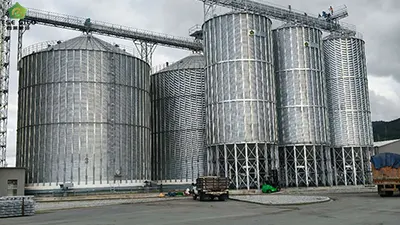
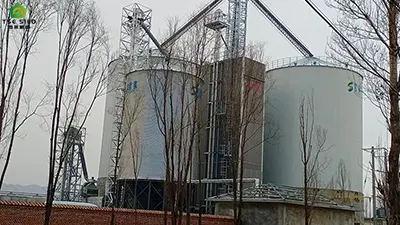
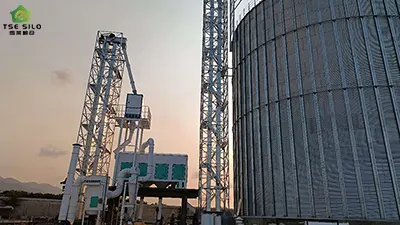
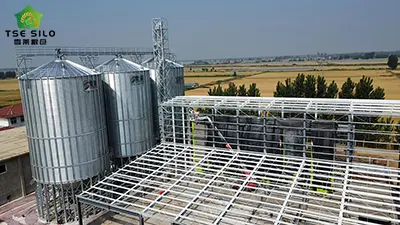
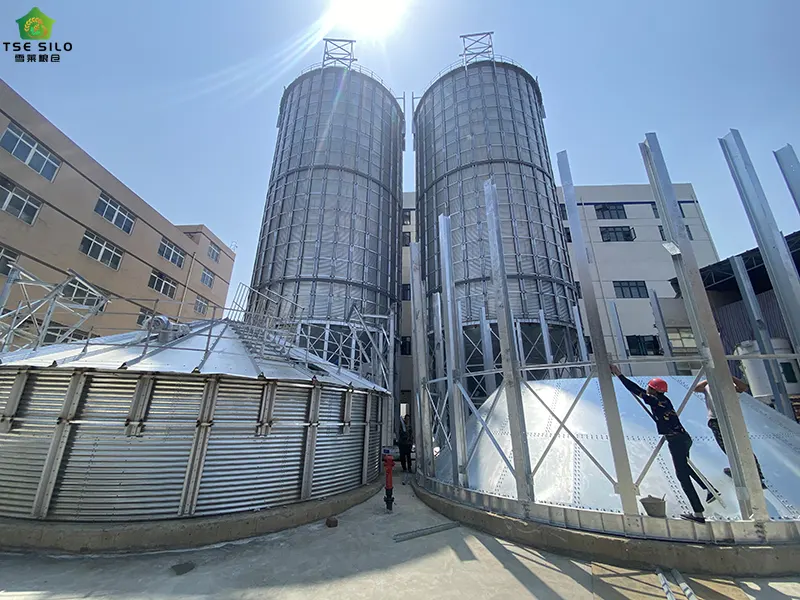
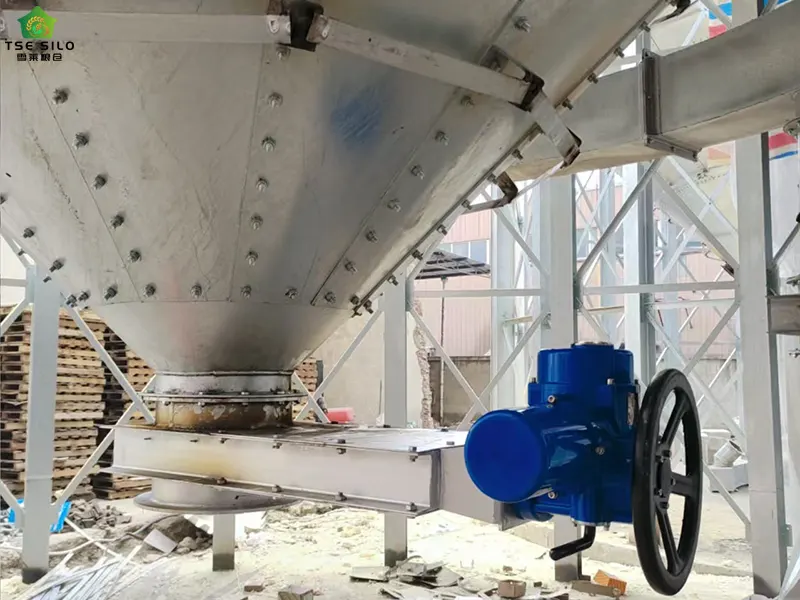
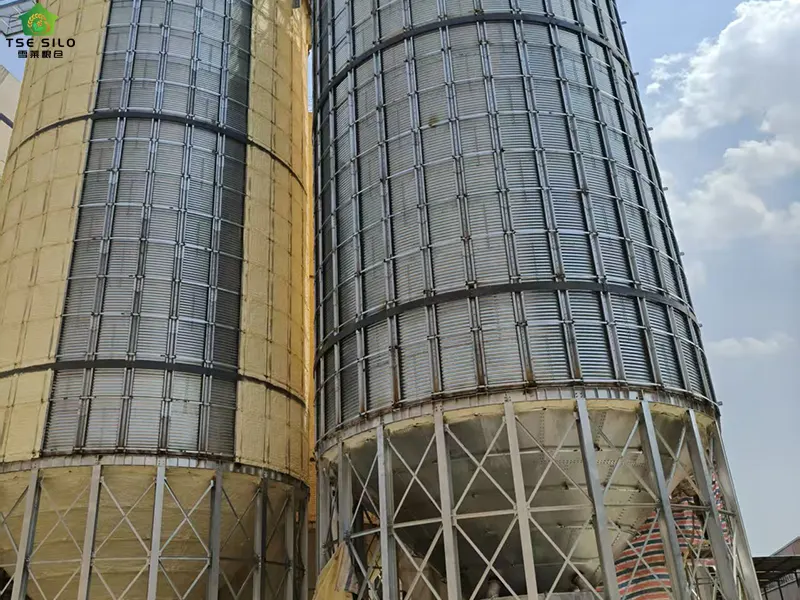
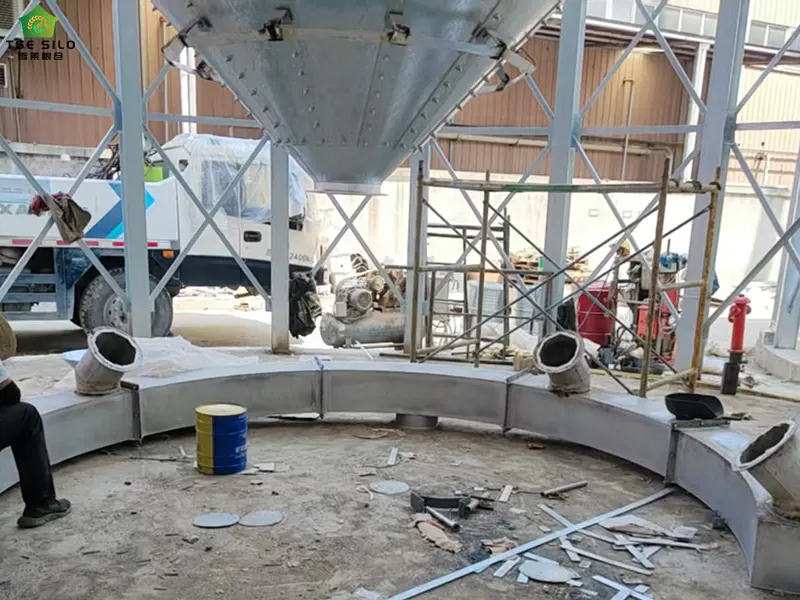
The grain drying process in grain steel silos is a complex system involving thermal engineering, mechanics, and automatic control. It plays a crucial role in grain storage, ensuring safe storage and significantly improving efficiency. However, various malfunctions can occur during operation, affecting drying efficiency, grain quality, and even production safety. Rapid response is essential. Today, Shelley Storage will explain common malfunctions in the grain drying process in steel silos and their solutions.
1. Temperature Control Malfunctions
1.1. Drying temperature is too high or too low, with large fluctuations.
Cause Analysis:
- Hot air furnace burner malfunction (unstable fuel supply, nozzle blockage, ignition failure).
- Temperature sensor malfunction or improper installation location.
- Hot air valve actuator malfunction or improper PID parameter settings.
- Cold air mixing ratio out of control.
Solutions:
- Regularly clean and maintain the burner to ensure stable fuel quality.
- Verify and replace damaged temperature sensors, ensuring they are located at representative measuring points.
- Inspect valve actuators and recalibrate or optimize control system parameters.
- Check the sealing of hot and cold air ducts and the condition of dampers.
1.2. Hot air temperature meets target, but grain temperature rises slowly.
Cause analysis:
- Hot air short circuit: Uneven grain stacking or voids prevent effective penetration of hot air into the grain layer.
- Insufficient airflow: Degraded fan performance, blocked ducts, or severe air leakage.
- Initial grain moisture content is too high or flow rate is too high.
Remedial measures:
- Adjust the distributor to ensure even grain distribution in the silo; regularly check and remove bridging within the silo.
- Inspect fan belts and bearings, clean air ducts (especially heat exchanger fins), and seal any leaks.
- Adjust the drying tower output (reduce flow rate) or use segmented drying based on the initial grain moisture content.
2. Moisture control related faults
2.1. Uneven grain moisture content after drying (localized areas are too dry or too wet).
Cause Analysis:
- Uneven resistance in the grain layer (e.g., areas with impurity accumulation, varying degrees of compaction).
- Uneven hot air distribution (blockage or deformation of the air distribution plate or ventilation floor).
- Uneven rotation speed of the grain discharge mechanism, resulting in different heating times for different parts of the grain.
Remedial Measures:
- Strengthen initial cleaning to remove large and light impurities; adopt multi-point feeding and unloading.
- Regularly inspect and clean the air distribution plate to prevent grain particles or impurities from clogging the openings; repair deformed parts.
- Inspect the grain discharge motor, gearbox, and scraper to ensure uniform grain discharge speed.
2.2. Continuously high moisture content in the dried grain.
Cause Analysis:
- Insufficient hot air temperature or air volume (see Category I fault).
- Excessively fast grain discharge speed, resulting in insufficient residence time of the grain in the high-temperature zone.
- Extremely high ambient air humidity, affecting the moisture reduction effect.
Remedial Measures:
- Prioritize resolving hot air and air volume issues.
- Adjust the discharge motor speed automatically or manually based on real-time moisture detection feedback.
- In extremely humid weather, appropriately increase the hot air temperature or reduce the processing capacity.
3. Mechanical and Conveying Faults
3.1. Discharge Mechanism Jamming or Stoppage.
Cause Analysis:
- Large impurities (such as corn cobs, stones) or arched grain jamming the scraper or auger.
- Damaged or insufficiently lubricated transmission components (bearings, chains, gears).
- Motor overload (such as unstable voltage, insufficient torque).
Remedial Measures:
- Emergency shutdown, clear blockages; strengthen pre-feed cleaning.
- Regular lubrication and maintenance, replace damaged parts.
- Check the electrical system, install overload protection devices.
3.2. Fault Phenomenon: Elevator or conveyor malfunction causing drying operation interruption.
- Cause Analysis: Belt misalignment, slippage, or breakage; bucket detachment; material blockage.
- Remedial Measures: Adjust the tensioning and correction devices; regularly check the bucket bolts and belt joints; install and promptly clean the material blockage sensor.
4. Heat Source System Failure (Taking Coal/Gas Furnace as an Example)
Low efficiency of the hot blast stove, black smoke emission, or difficulty in ignition.
Cause Analysis:
- Fuel problems (poor coal quality, insufficient gas pressure).
- Damaged grate, coking inside the furnace, severe ash accumulation.
- Inappropriate forced draft/induced draft ratio, incomplete combustion.
Remedial Measures:
- Control fuel quality; check gas supply pressure.
- Regularly clean the furnace and remove slag; repair or replace the grate.
- Adjust the forced draft/induced draft fan dampers to ensure a slight negative pressure in the furnace and complete combustion.
5. Electrical and Automatic Control System Failure
Control system malfunction (abnormal or unadjustable display of temperature, moisture, material level, etc.).
Cause Analysis:
- PLC module, touch screen malfunction.
- Sensor signal lines are interfered with or open-circuited.
- Inverter or soft starter malfunction.
Remedial measures:
- Restart the system, check PLC status; back up and replace faulty modules.
- Check wiring, use shielded cables and ensure proper wiring.
- Reset or replace the inverter, check motor insulation.
6. Structural and Safety Faults
6.1. Grain arching (blockage) in the silo.
Cause analysis:
- High grain moisture content, many impurities; improper design of the silo cone angle or rough rust on the inner wall.
Remedial measures:
- Prioritize using a multi-point unloading or circulating unloading system at the bottom of the silo.
- Install a vibration arch-breaking device or air cannon, activating it promptly in the early stages of blockage.
- Strictly prohibit personnel from entering the silo for hazardous operations; if necessary, use a long pole to clear the blockage from the outside.
6.2. Dust explosion risk or fire.
Cause analysis:
- Dust accumulation (especially in high-temperature areas); prolonged overheating and carbonization of grain; electrical equipment not explosion-proof.
Handling Measures:
- Top Priority! Strictly implement dust removal procedures (including silo roof, equipment interior, and floor).
- Install fireproof baffles on hot air ducts; automatically cut off fuel supply when temperatures exceed limits.
- Use explosion-proof electrical equipment and lighting fixtures, and ensure proper grounding.
- Provide sufficient fire extinguishing equipment (such as inert gas extinguishing systems).
7. Systematic Maintenance and Prevention Strategies
- 7.1. Daily Inspection: Check temperature and moisture meter displays, listen to equipment operating sounds, and check for grain leaks, air leaks, and smoke.
- 7.2. Regular Maintenance: Clean sensors weekly, lubricate moving parts, check belt tension, and clean the primary cleaning screen. Thoroughly clean air ducts, heat exchangers, and silo interiors annually; calibrate all sensors; overhaul burners; and test safety devices.
- 7.3. Operational Training: Ensure operators understand the process flow and can identify initial signs of malfunction (such as abnormal temperature fluctuations and abnormal current increases).
- 7.4. Spare Parts Management: Stockpile critical spare parts, such as temperature sensors, bearings, belts, and relays, to minimize downtime.
Summary: The stable operation of a grain steel silos drying system depends on "uniformity" (air, heat, grain), "cleanliness" (fuel, grain, equipment), and "reliability" (mechanical, electrical, control). Establishing a prevention-oriented maintenance system, combined with intelligent monitoring and precise operation, is key to minimizing malfunctions and ensuring efficiency and safety.
The above is a summary of common malfunctions and troubleshooting measures in the grain steel silo drying process, compiled and published by Shelley Storage. We hope this information will be helpful in your future operation of grain steel silos.
Written by
Shandong Shelley Grain Steel Silo Co., Ltd
Editor Jin
WhatsApp : +86-18653877118
Email : shelley@cnshelley.com