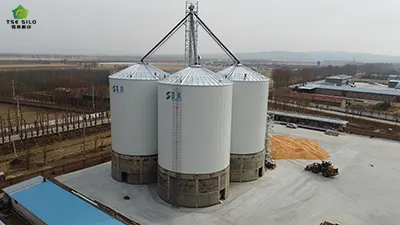
With the popularization of mechanization in the grain planting industry, storage efficiency in the grain storage industry has become the main factor restricting the entire grain production. In many cases, due to the slow storage speed, the grain cannot be quickly stored, resulting in mold and deterioration. In terms of improving the efficiency of grain storage, the warehousing and outbound systems have played a very important role. Currently, most of the most advanced warehousing and outbound systems use pneumatic conveying systems. It can not only use a multi-point warehousing method to quickly enter the grain, but also can be combined with a drying system to complete the drying and warehousing work at one time, which perfectly solves the problem of grain storage efficiency constraints. Below we will mainly explain the components and main advantages of the pneumatic conveying system of grain steel silo.
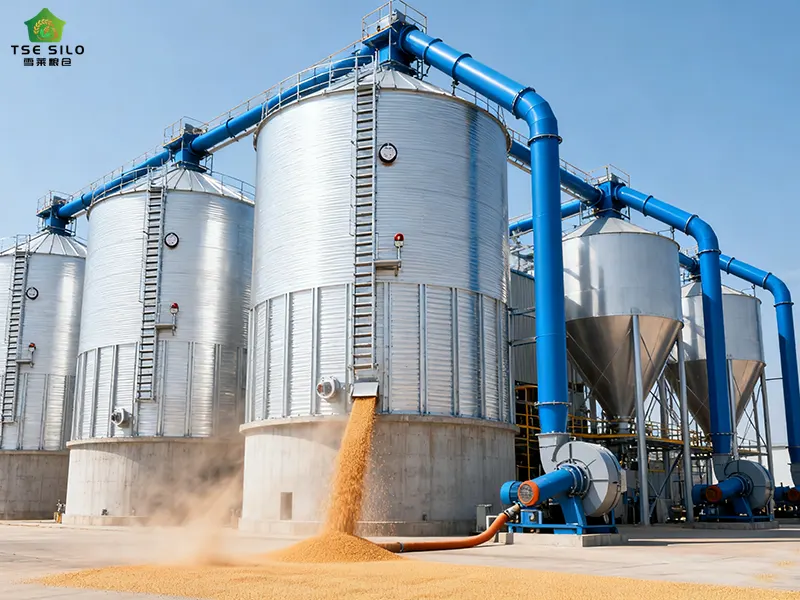
I. Main Components of a Pneumatic Conveying System
1. Power Source - Air Supply
This is the heart of the system, responsible for providing the airflow and pressure required for conveying.
- Roots Blower: This is the most commonly used device. It is a positive displacement blower that provides stable airflow and high pressure (typically 0.1-1 bar), making it ideal for medium- and low-pressure, dense-phase, or semi-dense-phase conveying. It is typically equipped with an air inlet silencer and a safety valve.
- Air compressors: Primarily used in high-pressure, dense-phase conveying systems, they provide higher air pressures (typically several bar) at lower air velocities, significantly minimizing material breakage.
2. Dispensing and feeding devices
This is the "throat" of the system, responsible for delivering the material into the airstream in a stable and controllable manner. The key equipment varies depending on the conveying method (suction, pressure, dense phase, or dilute phase).
- Rotary valves (air locks): This is a key piece of feeding equipment. It ensures uniform material discharge (from the hopper to the pipeline) and acts as a gas lock, preventing high-pressure air from backflowing from the dispensing end into upstream equipment. Its sealing and wear resistance are crucial.
- Dispensing tanks (silo pumps): Used in dense-phase pressure conveying systems. These pressure vessels operate as follows: feed → inflation and pressurization → fluidization → discharge. They enable low-speed, high-concentration, and high-capacity conveying with minimal breakage.
- Suction nozzles: Used in negative pressure (suction) systems, typically used for unloading from trucks, ships, etc., inserted into grain piles to extract grain using negative pressure.
- Feeders: Such as screw feeders and impeller feeders, used to steadily control material flow.
3. Conveying Pipelines and Accessories
These are the "blood vessels" of the system, through which the mixture of material and air flows.
- Conveying Pipelines: Typically made of wear-resistant seamless steel or alloy steel pipes, they require a smooth interior to reduce resistance. The pipe diameter is designed based on the conveying volume and distance.
- Elbows: Components most susceptible to wear typically require wear-resistant treatments such as thickening, ceramic lining, or cast stone.
- Distributors (Diverter Valves): Used to direct the material flow to different target silos, they are key equipment for achieving "one pipe to multiple silos" and are typically controlled electrically or pneumatically.
4. Separation and Dust Removal Equipment
These are the "lungs" of the system, separating air from the material before it enters the silo.
- Centrifugal Discharger (Cyclone Separator): Utilizing centrifugal force for primary separation, the majority of the material (over 95%) is separated here and discharged into the silo through a bottom air lock (to prevent air leakage).
- Pulse Bag Dust Collector: Installed after the cyclone separator, it performs secondary fine separation, capturing fine dust. Clean air is discharged into the atmosphere via a fan, while collected dust can be directly returned to the silo or collected separately. This is core equipment for ensuring environmental compliance.
5. Control System and Safety Devices
This is the "brains and nerves" of the system.
- PLC (Programmable Logic Controller): Controls the automated operation of the entire system, including fan start and stop, rotary valve speed, distributor switching, and bin level monitoring.
- Valves and Sensors: These include pneumatic valves, level gauges, pressure sensors, and blockage sensors, used to monitor process status and execute control commands.
- Safety Devices: These include safety valves, vent discs (to prevent dust explosions), and pipe blockage alarms, ensuring safe system operation.
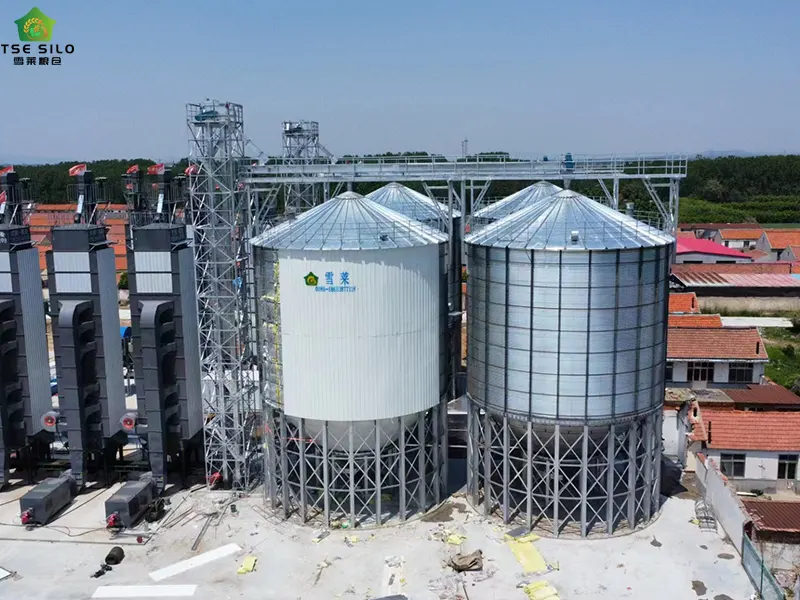
II. Key Advantages
1. Core Advantage: Perfectly Compatible with Grain Characteristics
1.1. Fully Enclosed Conveying Ensures Grain Safety and Hygiene
- Pollution Prevention: The entire pneumatic conveying system is completely enclosed, preventing grain from coming into contact with the outside world during transportation, effectively preventing contamination from dust, impurities, rainwater, insects, and rodents.
- Oxidation and Deterioration Prevention: The enclosed environment reduces grain's exposure to oxygen, which is particularly important for materials that need to maintain freshness (such as feed and germ), slowing oxidation and deterioration.
- Compliance with Hygiene Standards: This is crucial for processing industries like food and feed, meeting strict hygiene and safety regulations such as GMP and HACCP.
1.2. Flexible Layout, Adaptable to Complex Steel Silo Clusters
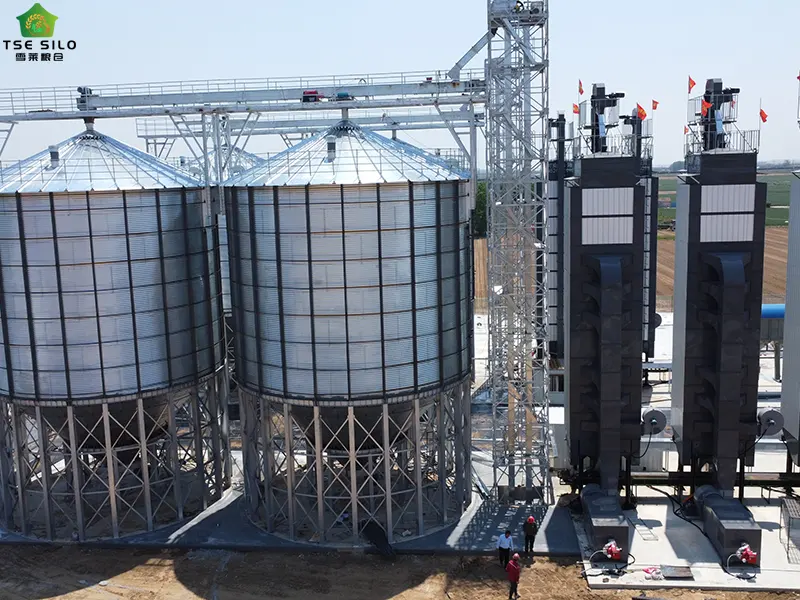
- Overcoming Spatial Constraints: Conveying pipelines can be flexibly arranged horizontally, vertically, or at an angle, bypassing obstacles and unrestricted by terrain and existing buildings. This is crucial for steel silo clusters, which are typically built in clusters and compactly arranged.
- Simplified process layout: Unlike mechanical conveying, which requires strict linear alignment, pneumatic conveying offers greater design freedom, enabling easy delivery of grain from multiple receiving points to any of multiple silos, achieving "point-to-multiple" or "multiple-to-one" transport.
- Long-distance transport: A single blower, combined with a duct system, can transport grain over distances of hundreds of meters or even longer, making it ideal for large grain storage facilities.
1.3. High Automation Improves Efficiency and Reduces Labor Costs
- Pneumatic conveying systems are easily integrated with PLCs (Programmable Logic Controllers) and DCSs (Distributed Control Systems) for fully automated control.
- Operators simply set parameters in a central control room to complete grain loading, unloading, and clearing operations, significantly reducing the number of on-site operators and their workload.
- Automated operation also reduces human error, ensuring consistent and reliable processes.
1.4. Significantly Reduces Grain Breakage, Ensuring Quality
- Compared to mechanical conveying equipment such as screw conveyors and scraper conveyors, pneumatic conveying (especially low-speed dense-phase conveying) eliminates direct contact between materials and moving mechanical parts, resulting in less friction and collision.
- For fragile grains such as beans, corn, malt, and rice, pneumatic conveying can significantly reduce breakage and mechanical damage, preserving the grain's integrity and commercial value. This is a key factor in choosing pneumatic conveying.
1.5. Contributes to "Green Grain Storage" and Environmental Protection
- No Dust Emission: A fully enclosed system combined with an effective dust collector (such as a pulse bag filter) virtually eliminates dust leakage, improving the working environment, avoiding the risk of dust explosions, and meeting environmental regulations.
- Reduced Loss: Dust is collected and directly recycled into the grain flow, minimizing material loss.
2. Advantages of Combining with Steel Silo Characteristics
- Perfectly Compatible with Silo Roofs: Steel silo roofs are typically conical or arched, limiting space. Pneumatic conveying requires only a single pipe, entering from the center or side of the silo roof, taking up minimal space and making installation easy. Mechanical conveying equipment (such as belt conveyors) requires a larger head drive and space for material delivery, making it difficult to install on the silo roof.
- Easy to distribute the material evenly: Pneumatically conveyed material enters the silo through a discharger (or spreader) on the silo roof, ensuring even distribution of the grain, avoiding the formation of concentrated cones. This reduces the occurrence of automatic grading (separation of particles by size) and facilitates subsequent storage management.
- Benefits of silo cleaning: For large steel silos, pneumatic suction systems can also be used for cleaning operations, removing residual grain from corners at the bottom of the silo for efficient cleaning.
3. Comparison with Other Conveying Methods
For a better understanding, it can be compared with common mechanical conveying methods:
| Features |
Pneumatic Conveying |
Screw Conveyor |
Scraper Conveyor |
Belt Conveyor |
| Containment |
Excellent |
Good |
Fair |
Poor (requires a hood) |
| Flexibility |
Excellent |
Medium |
Medium |
Poor |
| Crushing Rate |
Low |
High |
High |
Low (but high at drop heights) |
| Automation |
High |
Medium |
Medium |
Medium |
| Dust Control |
Excellent |
Poor |
Poor |
Poor |
| Maintenance Points |
Fewer (primarily fans and elbows) |
More (bearing and blade wear) |
More (chain and scraper wear) |
More (rollers, idlers, and belts) |
| Energy Consumption |
Higher |
Medium |
Medium |
Low |
| Space Occupancy |
Small (Pipeline) |
Medium |
Medium |
Large (Corridor) |
Conclusion
An efficient and reliable pneumatic conveying system is the result of the precise coordination of these devices. Its design and selection must be determined based on specific parameters such as grain type (particle size, specific gravity, friction), conveying volume, conveying distance, and plant layout. The core goal is to achieve efficient, low-breakage, low-energy, safe, and environmentally friendly grain transportation. The grain industry chooses pneumatic conveying to deliver grain to grain steel silo because it offers unparalleled layout flexibility and high automation capabilities while ensuring grain quality (low breakage, anti-contamination) and safety (explosion-proof, environmentally friendly). While its initial investment and energy consumption may be relatively high, in terms of overall operating costs, grain preservation value, environmental protection, and long-term automation benefits, pneumatic conveying is one of the optimal, most reliable, and most mainstream options for modern large-scale grain logistics and storage systems.
Written by
Shandong Shelley Grain Steel Silo Co., Ltd
Editor Jin
WhatsApp : +86-18653877118
Email : shelley@cnshelley.com