LANGUAGE
Flat bottom grain silos are the highest-capacity, most cost-efficient bulk storage assets on most commercial grain sites. They are also the most mechanically dependent: unlike hopper-bottom designs, flat bottom grain silos cannot rely on gravity to move grain. Discharge depends on sweep augers, conveyors, and aeration floors that must all function on the first day of harvest—not the third.
The economics of neglect are well documented. Commercial elevators lose 0.5% to 2% of stored grain each year to preventable spoilage, mold, and insect damage. Reactive repairs cost $0.018–$0.024 per tonne handled, compared with $0.006–$0.009 per tonne for planned maintenance—a 2.5x to 3x gap. A preventive maintenance schedule can cut unscheduled silo downtime by up to 65% and extend equipment life by 8–12 years.
This checklist is organized around the ten items that most directly determine whether flat bottom grain silos enter the harvest season structurally sound, airtight, mechanically reliable, and safe for personnel. Each item includes the quantified risk of skipping it and the recommended inspection timing.

The foundation carries the full dead load of stored grain—often several thousand tonnes—across the entire flat base. Water ingress at the wall-to-foundation junction is the most common foundation failure mode in flat bottom grain silos, and it is far cheaper to prevent than to repair.
Inspect: cracks, spalling, and uneven settlement at the ring beam; anchor bolt torque and corrosion; the waterproof seal between wall and foundation; drainage paths around the base; and the internal concrete surface for pitting or moisture penetration.
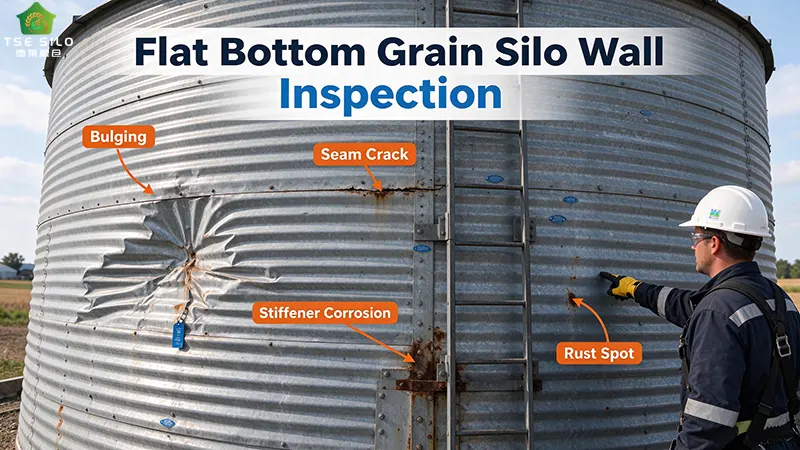
The wall of a flat bottom grain silo reaches maximum lateral pressure at the base—exactly where condensation accumulates and corrosion progresses fastest. Over successive fill-and-empty cycles, steel can bulge, seam cracks can open, and stiffeners can detach.
Inspect: localized bulging, dents, or buckling (especially in the lower third); vertical and horizontal seam cracks; rust breakthrough and white rust; stiffener rings and vertical stiffeners for bending or detachment; and overall verticality with a plumb line or theodolite.
Decision rule: Mild, uniform plate deflection can be normal under load. Asymmetric or progressive bulging indicates the steel is approaching its yield limit and requires engineering assessment before filling.
The roof is the first barrier against rain and humidity. Because flat bottom grain silos have large roof areas, even a small gasket failure can admit enough water over a season to create a spoilage pocket in the top grain layer.
Inspect: roof panels and seams for holes or loose fasteners; hatch, manhole, and inspection-door gaskets; vent caps and pressure-relief valves; the roof-to-wall sealant line; gutters and drainage channels; and roof-mounted ladders, walkways, and railings.
Sealing serves two functions in flat bottom grain silos: it excludes external moisture and it enables effective fumigation or controlled-atmosphere storage. A silo that cannot hold pressure cannot hold a fumigant.
Inspect: door and door-frame seals; all gaskets, lids, hatches, aeration inlets, and pressure-relief valves for hardening or shrinkage; double-seaming positions on spiral silos; and bolt connections and gaskets on bolted flat bottom grain silos for looseness and compression loss.
Test: Conduct a pressure test before every fumigation and at least once annually. For sealable silos, verify that the empty-silo pressure decay from 500 Pa to 250 Pa meets the applicable standard before the silo is approved for fumigation.
Aeration is the primary tool for controlling grain temperature and preventing moisture migration. In flat bottom grain silos, the aeration floor is both a functional and a structural component: blocked ducts create hotspots, while damaged floor plates create uneven support.
Inspect: clean ducts and plenum of dust, chaff, and residual grain; perforated floor plates for blockage, corrosion, and deformation; fan belts, bearings, and electrical connections; airflow uniformity with a handheld anemometer; and duct seals to prevent short-circuiting.
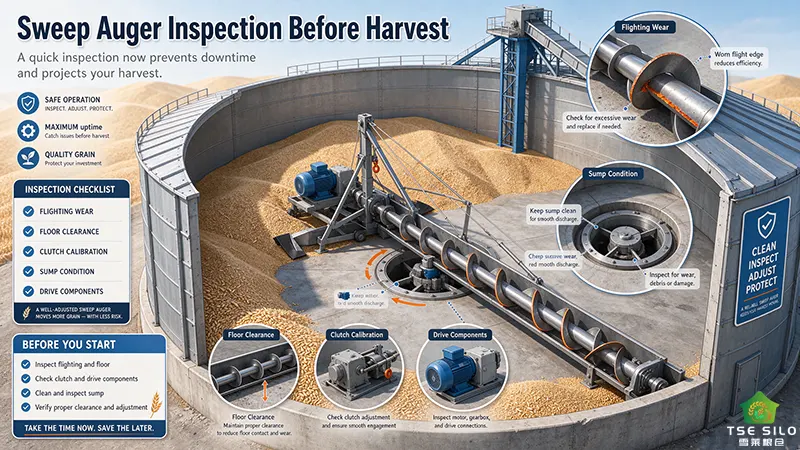
Flat bottom grain silos cannot discharge by gravity. Every tonne that leaves the silo passes through mechanical equipment—typically a sweep auger feeding a central sump. This is the highest-wear system in the entire storage facility.
Inspect: sweep auger flighting for wear at the outer end (the first 3 feet take the most abuse); drive motor, gearbox, chain tension, and carriage bearings; floor clearance (target 3–6 mm); pivot alignment; central sump for obstruction; safety guards and emergency stops; and clutch or shear-pin calibration.
Temperature and level data are the early-warning system for spoilage. In large flat bottom grain silos, the grain mass can develop stagnant zones that are invisible from the surface and difficult to aerate evenly without accurate sensor feedback.
Inspect: temperature cables for continuity and drift by comparing readings against a handheld thermometer; junction-box connections for corrosion; level indicators for accuracy; monitoring software for proper logging; and backup power for controllers.
Calibrate sensors before each harvest season and verify readings periodically during storage. A sensor that reads 2°C low can delay aeration until a hotspot has already established.
Residual grain and dust from the previous season are the primary inoculum for insect and mold problems in the new crop. In flat bottom grain silos, cleaning must extend beyond the visible floor to the aeration plenum, wall seams, and discharge tunnel.
Do: vacuum walls, floor, and plenum; clear the sweep auger tunnel and sump; remove grain residues from elevator boots, conveyor casings, and spouting; inspect for rodent activity and insect harborage; and apply food-safe diatomaceous earth or approved protectants where required.
Schedule: Complete deep cleaning 2–3 weeks before harvest. For large flat bottom grain silos (≥1,000 t), perform monthly surface and dead-corner inspections during storage and a full empty-and-clean cycle each quarter.
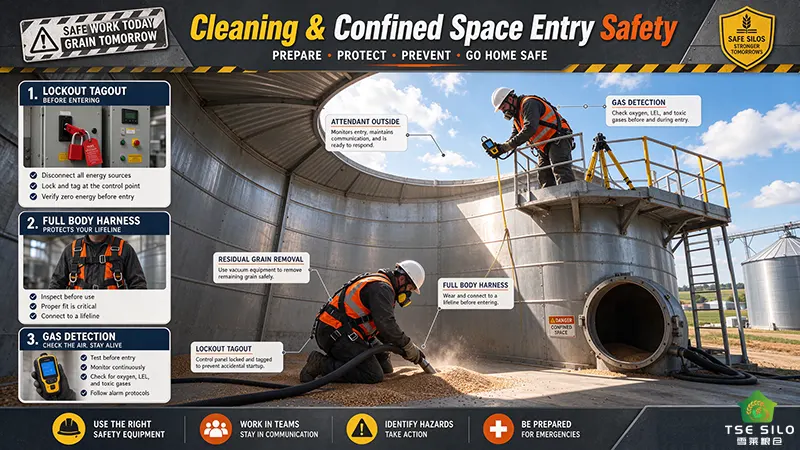
Cleaning, inspection, and unjamming work inside flat bottom grain silos places personnel in one of the most hazardous confined spaces in agriculture. The data is unambiguous: grain entrapment is the leading cause of confined-space fatalities in grain storage.
Verify before any entry: lockout/tagout of all powered equipment, including the sweep auger; gas detection for oxygen, CO₂, and fumigant residues; harness, lifeline, and retrieval system; a trained standby observer outside the silo; and a written entry permit. Never allow personnel to stand on the grain surface.
The final checklist item ties the mechanical and structural checks to the systems that protect the entire facility—and the people who operate it.
Inspect: electrical panels for moisture intrusion, corrosion, and tripped protection; cable glands and conduit for damage; lightning protection continuity and grounding; emergency lighting and exit routes; and the condition of ladders, platforms, guardrails, and fall protection anchor points.
Document: Record every finding, repair, and parts replacement in a maintenance log. Review the log before the next season and use it to adjust the inspection frequency for problem assets. Facilities that treat maintenance as a documented, condition-based program rather than a reactive expense reduce unplanned downtime by an average of 42% and maintenance spend by up to 28% in the first year.
| Timing | Checklist Item | Primary Risk Addressed |
| 6 weeks before | Item 1: Foundation, anchor bolts, drainage | Structural failure; water ingress |
| 5 weeks before | Item 2: Wall deformation, seams, stiffeners | Wall failure; grain leakage |
| 4 weeks before | Item 3: Roof integrity and opening seals | Moisture spoilage |
| 4 weeks before | Item 4: Airtight sealing and gaskets | Fumigation failure |
| 3–4 weeks before | Item 5: Aeration ducts, floor plates, fans | Hotspots; energy waste |
| 3 weeks before | Item 6: Sweep auger and discharge equipment | Unloading failure; downtime |
| 2–3 weeks before | Items 7 & 8: Sensors and cleaning/pest control | Undetected spoilage; contamination |
| 1–2 weeks before | Items 9 & 10: Safety equipment and final walk-down | Personnel injury; electrical failure |
Begin the formal checklist 4–6 weeks before harvest to allow time for concrete curing and parts procurement. Foundation and structural checks are annual. Aeration fan tests should be completed at least 14 days before receiving grain. Sweep auger clutches and drive systems should be tested annually before the season. Confined-space safety equipment and procedures should be verified 1–2 weeks before harvest.
Grain entrapment and engulfment. Purdue University's 2025 summary documented 48 confined-space cases, 22 of which were fatal (46%). Historically, about 58% of documented confined-space cases in grain facilities have resulted in death, and grain-related entrapments account for 58.6% of those incidents. Never enter a silo without lockout/tagout, a harness, a lifeline, gas testing, and a trained observer outside.
Aeration accounts for 60–75% of a silo's total electrical load. Climate zone can shift annual aeration costs by $0.12–$0.28 per tonne stored. Variable-frequency drives can cut aeration energy use by 25–35% versus fixed-speed systems. Clean ducts and efficient fans can reduce electricity consumption by 40–60% compared with a neglected system.
Over 40% of unloading failures are linked to drive-system overloads that proper clutch calibration could have prevented. Set the clutch to slip at 110–120% of rated motor torque and test it annually. A misaligned sweep auger can increase floor wear by 300% and leave up to 2 tons of grain unrecoverable per cycle in a 20-meter diameter silo.
Yes, substantially. Planned maintenance runs $0.006–$0.009 per tonne handled, compared with $0.018–$0.024 per tonne for reactive repairs—a 2.5x to 3x difference. Preventive programs can cut unscheduled downtime by up to 65% and extend equipment life by 8–12 years. Condition-based maintenance reduces unplanned downtime by an average of 42% and maintenance spend by up to 28% in the first year.
The ten items above cover the systems that fail most often and cost the most when they do: foundation and drainage, wall integrity, roof and opening seals, airtightness, aeration, sweep auger and discharge equipment, sensors, cleaning and pest control, confined-space safety, and electrical and fall protection.
The data supports a simple conclusion. Flat bottom grain silos that receive structured pre-season maintenance lose less grain, consume less aeration energy, experience fewer unloading failures, and expose workers to fewer hazards. The gap between planned and reactive maintenance is not marginal—it is a 2.5x to 3x cost difference, measured in dollars per tonne and in lost operating hours.
Start with the foundation six weeks out. Document every check. Treat the sweep auger clutch, the aeration floor, and the confined-space entry procedure as non-negotiable line items, not optional extras. A flat bottom grain silo is a long-life asset, but its reliability in any given harvest is determined by what was done in the weeks before the first truck arrived.
Written by
Shandong Shelley Grain Steel Silo Co., Ltd
Editor Jin
WhatsApp : +86-18653877118
Email : shelley@cnshelley.com