LANGUAGE
On a commercial farm, grain storage loss is not a rounding error. It is a direct deduction from revenue, and it compounds across every tonne handled. The gap between a well-managed galvanized steel silo and alternative storage methods is measurable in percentage points of loss—and those percentage points translate into six-figure differences on large operations.
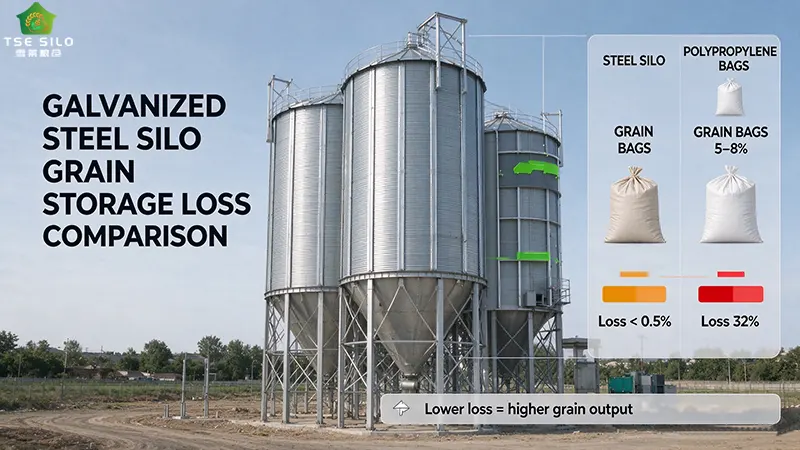
The benchmark data is consistent across geographies and studies. Galvanized steel silos equipped with aeration and proper sealing routinely hold storage losses below 0.5%. Grain bag systems, by contrast, average 5–8% moisture-related loss per season, and untreated polypropylene bags in tropical conditions have recorded weight losses of 32% after 270 days. On 10,000 tonnes of wheat at $250 per tonne, that is $12,500–$20,000 lost annually to bags versus roughly $1,250 for a steel silo.
This analysis breaks down the seven mechanisms through which galvanized steel silos cut storage loss, with the quantified data behind each one. The focus is commercial-scale operations, where the economics of loss prevention are most decisive.
The single most important loss-prevention mechanism in a galvanized steel silo is its airtight structure. When the silo is sealed, oxygen is consumed by grain respiration and any insects present. As oxygen concentration falls and carbon dioxide rises, insect populations collapse without chemical intervention.
The field data is unambiguous. In on-farm trials in Kenya comparing storage technologies after 270 days, grain weight loss was 1.5% in metal silos, 1.8% in hermetic bags, and 32% in polypropylene bags without insecticide. The metal silo and hermetic bag both suppressed insect populations and prevented cross-infestation from the surrounding environment, while the polypropylene bags allowed rapid population buildup and re-infestation.
For commercial farms, the implication is that galvanized steel silos replace a recurring chemical cost with a structural one. Fumigation becomes an occasional tool rather than a seasonal necessity, and the risk of resistance developing in stored-product insect populations is substantially reduced.
Moisture is the second major loss vector, and it is where galvanized steel silos establish a structural advantage over ground-based storage. Grain bags rely on passive temperature exchange and soil thermal mass. In practice, grain near the surface can swing 10–15°C in a single day, creating condensation pockets that push local moisture above 15%—the threshold for mold and mycotoxin development.
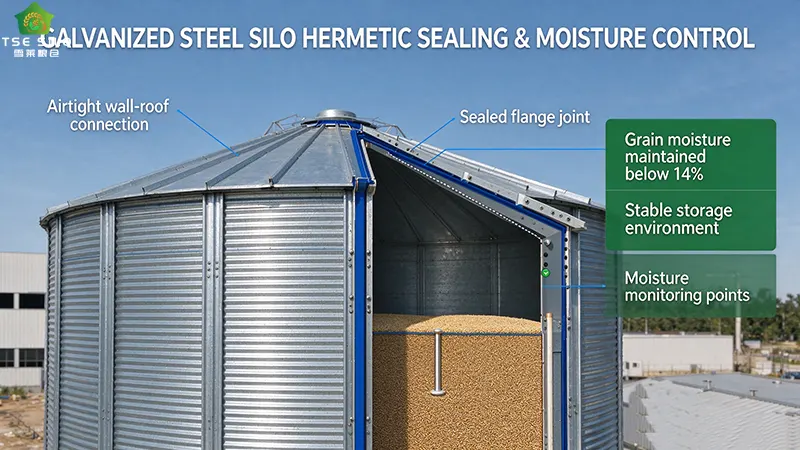
A properly designed galvanized steel silo with double-sealing belts and a sealed roof-to-wall connection prevents external humidity from entering the storage unit. The interior environment is decoupled from external weather. A corn silo using this design maintains grain moisture at ≤14% and minimizes storage losses to ≤0.5%.
The mold consequence is not merely quantitative. Aflatoxin contamination can render an entire lot unsaleable and, in some jurisdictions, legally unfit for feed or food use. Storage that prevents moisture migration prevents the conditions under which toxigenic molds establish.
The third loss mechanism is internal: temperature gradients within the grain mass drive moisture migration, and moisture migration creates hotspots. Galvanized steel silos are engineered to accept aeration systems that interrupt this cycle before spoilage establishes.
A properly designed silo aeration system with 0.1–0.2 CFM per bushel of airflow keeps the entire grain mass within 1–2°C of ambient, preventing the formation of hot spots. Without adequate ventilation, hot spots can cause 5–10% grain loss in poorly ventilated silos, and proper aeration can cut drying costs by 15–25%.
The loss prevention is therefore twofold: aeration directly prevents the spoilage that occurs in stagnant zones, and it reduces the energy and shrink loss associated with over-drying. On a commercial scale, the difference between a ventilated galvanized steel silo and a storage system without active airflow is the difference between a controlled environment and a reactive salvage operation.
Physical loss from rodents and birds is often underreported because it occurs progressively and is difficult to attribute to a single event. Grain bags are routinely penetrated by rodents, causing 2–3% physical loss per infestation. Open warehouses and ground piles are similarly vulnerable.
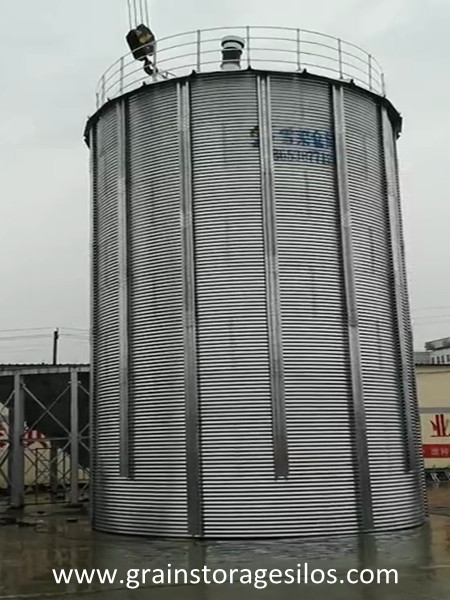
Galvanized steel silos present a continuous steel barrier from foundation to roof. There are no seams accessible to rodents, no fabric to chew through, and no open surfaces exposed to birds. Access doors, inspection hatches, and ventilation openings can be fitted with screens or sealed closures.
This loss vector is particularly relevant on farms that store grain for extended periods. A rodent infestation in a bag system can establish within weeks and persist until the bags are emptied. In a sealed galvanized steel silo, the same population has no entry point and no food source.
Corrosion is an indirect but persistent loss mechanism. When the interior wall of a steel silo rusts, rust flakes and corrosion byproducts contaminate the grain in contact with the wall. Mildewed grain attached to the wall can accelerate the galvanized layer’s degradation, creating a cycle of contamination and structural decline.
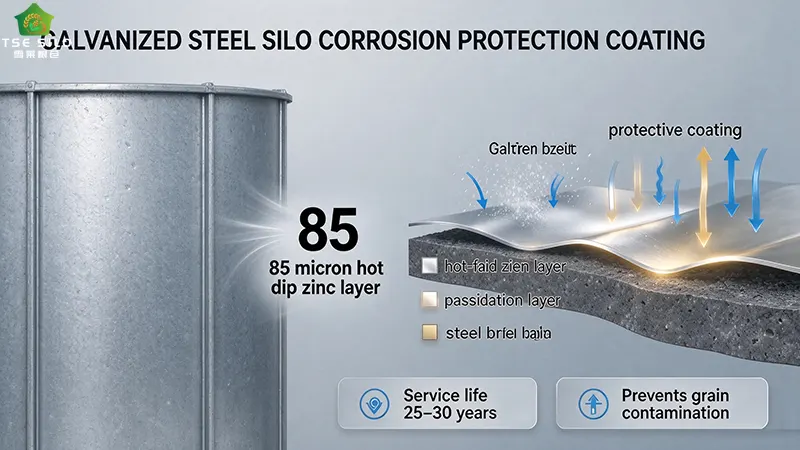
The galvanized coating on a quality galvanized steel silo is specified to prevent this. Hot-dip galvanizing at 85 µm delivers 25–30 years of coating life in most environments. Standard specifications call for 275 g/m² minimum zinc coating, with coastal and high-humidity installations requiring 100 µm or a duplex galvanizing-plus-epoxy system. Some specifications indicate a zero-maintenance period of up to 20 years for the galvanized layer alone.
For commercial farms, the loss-prevention value of corrosion protection is straightforward: a silo that does not rust does not contaminate grain, and it does not require the interior to be emptied and recoated on a short cycle.
Not all storage loss is measured in tonnes. Grain that remains physically intact but drops in grade—due to breakage, stress cracking, or loss of test weight—sells at a discount. Repeated handling and uneven temperature stress are primary causes of breakage.
Galvanized steel silos reduce breakage through two mechanisms. First, the sealed, aerated environment maintains uniform conditions, and uniform conditions produce fewer stress fractures than the temperature cycling characteristic of bag or open storage. The documented benefit is that temperature variation causes fewer grain breaks, producing better quality grain. Second, a silo-based system replaces the multiple handling steps of bag filling, stacking, and unloading with a single fill and a controlled discharge, reducing mechanical impact.
For commercial operations selling into milling, malting, or seed markets, the grade premium preserved by consistent storage conditions often exceeds the value of the weight loss avoided. Grade is a revenue line item, not just a quality metric.
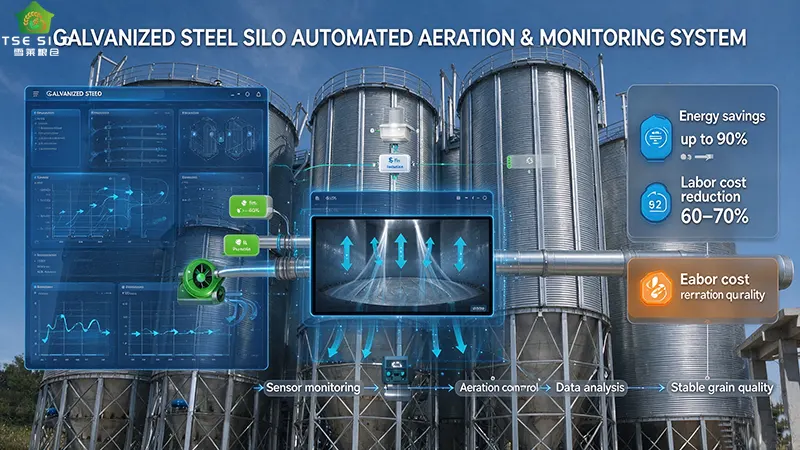
The final loss-prevention mechanism is operational. A significant share of storage loss in commercial settings is attributable to delayed response—fans not switched on when conditions changed, a leak not noticed until the surface crusted, a fumigation that was not properly sealed. Automation addresses this directly.
Galvanized steel silos are compatible with temperature and moisture monitoring systems that track conditions continuously. Automated aeration using variable speed drives and thermometry-based control saves up to 90% of aeration energy by running fans only when grain conditions require it. At the system level, high-efficiency fans and variable frequency drives reduce aeration power consumption by 30–40% while maintaining target temperatures.
The labor dimension reinforces the economics. Bag systems require 3–4 workers for filling and another 2–3 for unloading, with each cycle taking 2–3 days per 500-tonne bag. A steel silo with a conveyor system handles the same volume with one operator and a control panel, cutting labor costs by 60–70%—approximately $4,800 saved per 10,000 tonnes annually at a $20/hour labor rate.
| Mechanism | Primary Loss Vector Addressed | Quantified Impact |
| Hermetic sealing | Insect infestation | 1.5% loss vs 32% in untreated bags (270 days) |
| Airtight construction | Moisture ingress / mold | Grain moisture held ≤14%; loss ≤0.5% |
| Active aeration | Hotspots / moisture migration | Prevents 5–10% loss in poorly ventilated storage |
| Structural barrier | Rodents and birds | Eliminates 2–3% physical loss per infestation |
| Galvanized coating | Corrosion contamination | 25–30 year coating life; zero-maintenance period up to 20 years |
| Uniform conditions | Grain breakage / grade loss | Fewer breaks; preserved market grade |
| Automation | Delayed response / labor error | Up to 90% aeration energy savings; 60–70% labor reduction |
Galvanized steel silos with proper aeration and sealing typically hold storage losses below 0.5%, compared with 5–8% for grain bag systems and up to 32% for untreated polypropylene bags in tropical conditions. On a 10,000-tonne annual operation, this difference represents 50–80 tonnes of grain saved per year.
For farms storing more than 5,000 tonnes annually, galvanized steel silos typically pay back their premium over grain bags in under 3 years through reduced spoilage and labor savings. A 10,000-tonne operation loses $12,500–$20,000 annually to bag-system spoilage, compared with roughly $1,250 for a steel silo.
A hot-dip galvanized steel silo typically has a design service life of 25–30 years, with 85 µm coating delivering 25–30 years in most environments. Annual maintenance runs approximately $0.50–$1.50 per ton stored. Some specifications indicate a zero-maintenance period of up to 20 years for the galvanized layer alone.
Standard galvanized steel performs well in most inland climates, but coastal areas with salt spray can show significant corrosion within 5–7 years. For these environments, specify a heavier coating—100 µm rather than 85 µm—or a duplex system such as galvanizing plus epoxy coating, which extends service life to roughly 35 years at an 8–10% cost premium.
Automated aeration systems using variable speed drives and thermometry-based control can save up to 90% of aeration energy by running fans only when grain conditions require it. At the system level, high-efficiency fans and variable frequency drives reduce aeration power consumption by 30–40% while maintaining target grain temperatures.
The seven mechanisms above are not marginal refinements. They address the full set of loss vectors that determine whether a commercial storage operation protects its crop or leaks value throughout the season: insects, moisture, hotspots, rodents, corrosion, breakage, and delayed response.
The financial arithmetic is consistent across sources. Galvanized steel silos reduce grain loss from the 5–8% range typical of bag systems to under 0.5%. On a 10,000-tonne operation, that is 50–80 tonnes saved annually. The capital premium over lower-cost alternatives is recovered in under 3 years for operations above 5,000 tonnes, and the asset continues to deliver loss prevention for 25–30 years with maintenance in the $0.50–$1.50 per tonne range.
For commercial farms, the relevant question is not whether a galvanized steel silo costs more on day one. It is what the alternative costs in lost grain, lost grade, and lost labor across every season the storage decision remains unchanged. The data indicates that the more expensive question is delay.
Written by
Shandong Shelley Grain Steel Silo Co., Ltd
Editor Jin
WhatsApp : +86-18653877118
Email : shelley@cnshelley.com