LANGUAGE
The global agri-food industry is under increasing pressure to reduce its environmental impact. Agriculture and food storage contribute significantly to global greenhouse gas emissions, with post-harvest food loss alone identified as a major driver of climate change. As environmental awareness grows and supply chains become more complex, manufacturers and farmers alike are seeking storage solutions that protect grain quality while minimizing ecological harm.
Steel silos have emerged as a cornerstone of sustainable grain storage. Far more than simple containers, modern steel silos incorporate advanced materials, intelligent technologies, and circular design principles that actively reduce carbon emissions across their entire lifecycle. From extending service life to preventing food waste, steel silos offer multiple pathways to a lower-carbon future for grain storage.
This article explores six key ways steel silos contribute to carbon footprint reduction and support sustainable agriculture worldwide.
The most effective way to reduce the carbon footprint of any industrial product is to make it last longer. Every time a silo needs to be replaced, new materials must be mined, processed, manufactured, and transported—each stage generating significant CO₂ emissions.
Extending the operational life of a grain silo is essential in reducing both capital expenditure and the carbon footprint associated with manufacturing and transportation. Steel silos, particularly those built with advanced coatings and high-quality galvanized steel, are engineered to remain functional and safe for decades.
Innovations in materials science have dramatically extended silo lifespans. ProMag, an advanced metal coating composed of aluminum, zinc, and magnesium, provides over 10 times better corrosion resistance than traditional galvanized steel, according to ISO 9223. This resistance to harsh environments extends silo lifespan dramatically, reducing long-term maintenance and material waste. Moreover, ProMag uses less zinc than conventional coatings, making it an environmentally responsible choice without sacrificing performance.
The principle is simple: a silo that lasts 40 years instead of 20 requires half the manufacturing emissions over the same storage period. By reducing the frequency of replacement and minimizing material degradation, silos built with advanced coatings reduce both operational costs and environmental footprint.
The amount of steel required to build a silo directly determines its embodied carbon—the emissions generated during raw material extraction, processing, and manufacturing. Modern steel silo design uses high-strength steel to achieve the same structural performance with significantly less material.
High-yield strength steel, ranging from 450 MPa in wall sheets to 600 MPa in reinforcements, enhances structural performance while reducing the overall weight of the installation. Using high-strength steel with yield strengths exceeding 550 MPa allows for a 15%–20% reduction in steel consumption for the same storage capacity, while simultaneously improving wind and seismic resistance.
This lightweight design delivers multiple carbon reduction benefits:
Steel silos using optimized structural design can reduce overall weight by up to 58% compared to conventional over-designed alternatives, with corresponding reductions in material-related emissions.
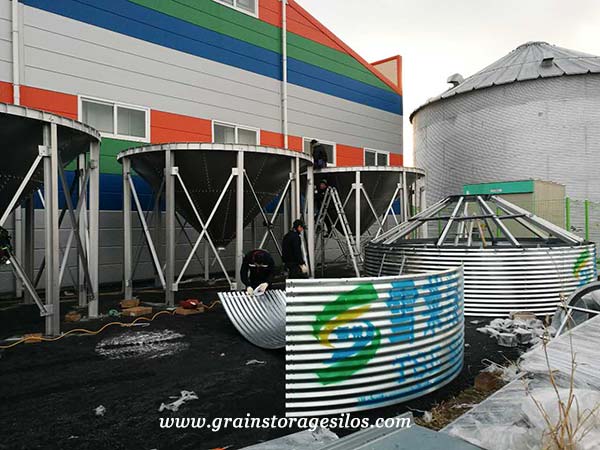
The use of modular and bolted construction further enhances sustainability. Large silos can be prefabricated as standard modules in the factory and quickly assembled on-site, with construction time reduced by more than 50% compared to traditional welded silos. This approach reduces construction-related carbon emissions and minimizes on-site environmental disruption.
Food waste is a major contributor to global greenhouse gas emissions. According to the FAO, post-harvest food loss is a major driver of global greenhouse gas emissions. When grain spoils in storage, all the emissions generated during its production—fertilizer manufacture, tractor fuel, irrigation, harvesting, and transportation—are wasted along with the grain itself.
Steel silos address this problem at its source by providing superior grain preservation.
In China, pilot households using steel mini silos reported that average annual grain loss rates, previously at 8%, were reduced to below 2% . The reduction of post-harvest losses directly translates to lower carbon emissions per ton of grain consumed. Every ton of grain saved through better storage avoids the emissions that would have been required to produce replacement grain.
Hermetically sealed steel silos are particularly effective at preventing losses without chemicals. By creating a controlled, low-oxygen environment, metal silos suppress insect populations, prevent grain loss, and prevent cross-infestation of insects from the surrounding environment. Studies have documented that metal silos can reduce grain weight losses to under 1.5%, compared to over 30% in traditional storage bags.
Modern steel silos equipped with IoT sensors and automated controls can cut storage losses below 0.5% , compared to the 3%–5% typical of traditional warehouses. This near-elimination of storage loss represents a profound carbon reduction achievement: the emissions embedded in every kilogram of grain are preserved, not wasted.
Aeration systems are essential for maintaining grain quality, but they are also significant energy consumers. In the grain storage sector, ventilation system energy consumption accounts for up to 30% of total storage and transportation costs. Running high-capacity aeration fans based on guesswork or fixed schedules leads to massive utility inflation and unnecessary carbon emissions.
Modern steel silos address this through smart aeration and intelligent control systems.
Grain Storage 4.0 combines real-time monitoring, intelligent aeration, and predictive analytics to reduce losses and control energy consumption. Smart silos continuously monitor internal conditions—temperature, humidity, and CO₂ levels—detecting any deviation before quality is compromised. By integrating digital systems, aeration and drying equipment operate automatically only when external conditions are favorable, reducing losses and optimizing energy use.
The energy savings are substantial. Through technological innovation and refined management, ventilation energy consumption in steel silos can be reduced by over 40%, while improving grain quality. Storage units with efficient, properly sized ventilation systems can reduce electric energy consumption in the aeration process by up to 60% while keeping temperature homogeneous across the storage.
Additional sustainable features include:
These innovations lower the operational energy consumption of storage facilities and help maintain stable internal conditions even under extreme weather, ensuring material quality is preserved.
One of steel's greatest sustainability advantages is its infinite recyclability. Unlike concrete, which becomes construction waste at the end of its life, steel can be recycled repeatedly without loss of quality.
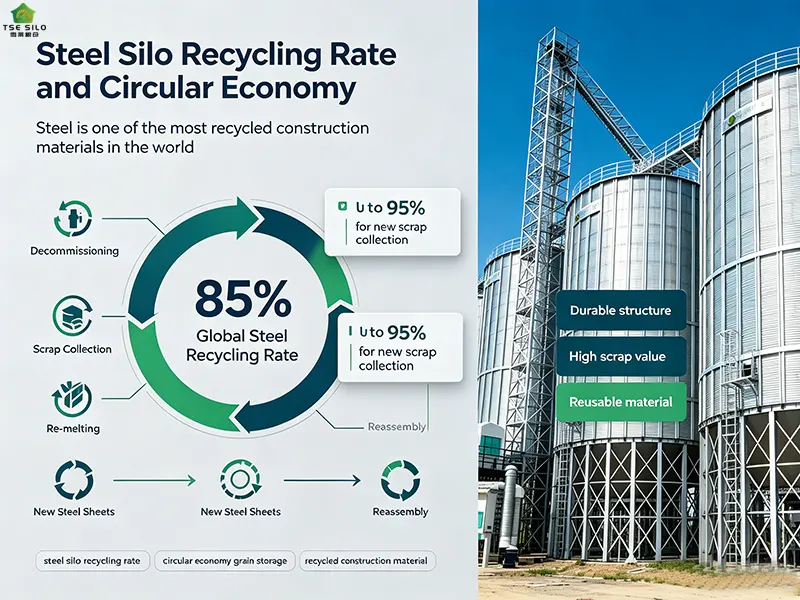
According to the World Steel Association, approximately 85% of steel worldwide is recycled at the end of its life cycle, making steel the most reused material in the construction sector. Steel retains its value over time and remains a high-value asset decades later—unlike concrete waste.
For grain storage, this means:
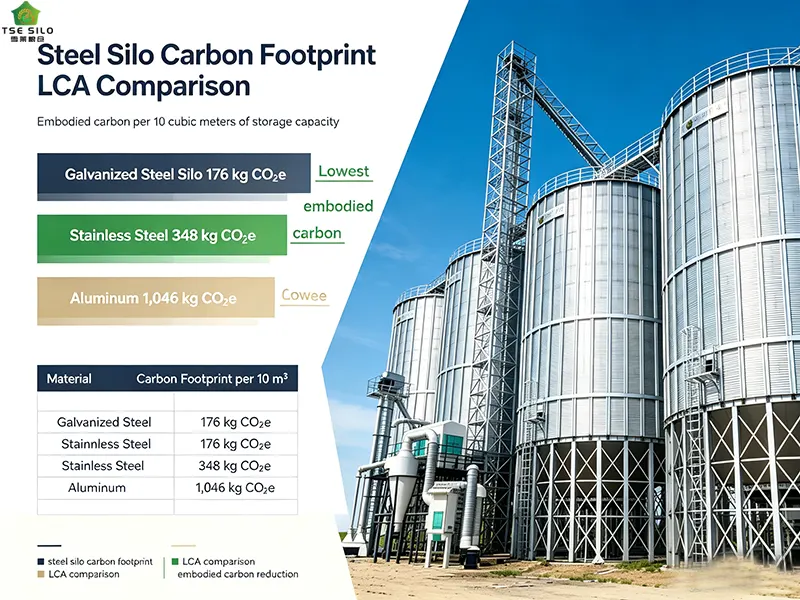
A modular silo made of galvanized steel has a significantly lower carbon footprint compared to alternatives in aluminum or stainless steel. A life cycle analysis found that a 10 cubic metre modular steel silo has an impact of only 176 kg CO₂e—far lower than aluminum (1,046 kg CO₂e) or stainless steel (348 kg CO₂e) alternatives.
The environmental advantage of galvanized steel becomes even clearer when comparing factors such as water scarcity. A steel silo uses only 4 cubic meters of water per cubic metre of capacity, far lower than other materials. Results also show that ozone layer depletion from galvanized steel silo production is equal to zero.
By choosing steel silos, operators are not just investing in storage—they are participating in a circular economy that minimizes waste and reduces carbon emissions across the entire material lifecycle.
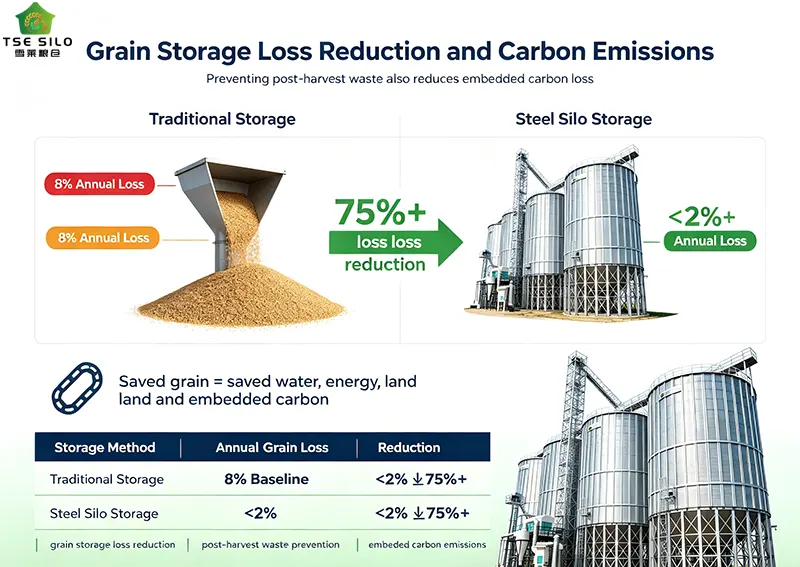
When evaluating the carbon footprint of grain storage, it is essential to consider the full lifecycle—from material extraction to end-of-life disposal. Steel silos consistently demonstrate lower embodied carbon than concrete alternatives across multiple metrics.
Steel silos use 30% less material than concrete structures for the same storage capacity. This material efficiency translates directly to lower manufacturing emissions. Steel silos also incorporate 100% recyclable components, while concrete structures have low recycling rates and generate significant construction waste at end-of-life.
Additional comparative advantages include:
Carbon discussions increasingly reference embodied emissions per year of service rather than per ton of material produced. Galvanized steel occupies a balanced zone between upfront emissions and lifetime performance. Fewer replacement cycles reduce steel melting, rolling, coating, packaging, and freight emissions—creating a compounding carbon reduction benefit over decades of service.
A Danish life cycle analysis confirmed that global warming is significantly lower when the silo is made of galvanized steel. The overall advantage of using galvanized steel becomes even clearer when comparing environmental factors such as water scarcity and ozone layer depletion.
The six pathways outlined above demonstrate that steel silos are not merely storage containers—they are active contributors to carbon footprint reduction and sustainable grain storage.
| Sustainability Benefit | Key Impact |
| Extended service life | Reduces manufacturing and transport emissions over decades |
| High-strength steel design | 15%–20% less material for same capacity |
| Post-harvest loss prevention | Losses reduced from 8% to under 2% |
| Smart aeration systems | Energy consumption reduced by over 40% |
| 100% recyclability | 85% global steel recycling rate |
| Lower embodied carbon | 30% less material than concrete |
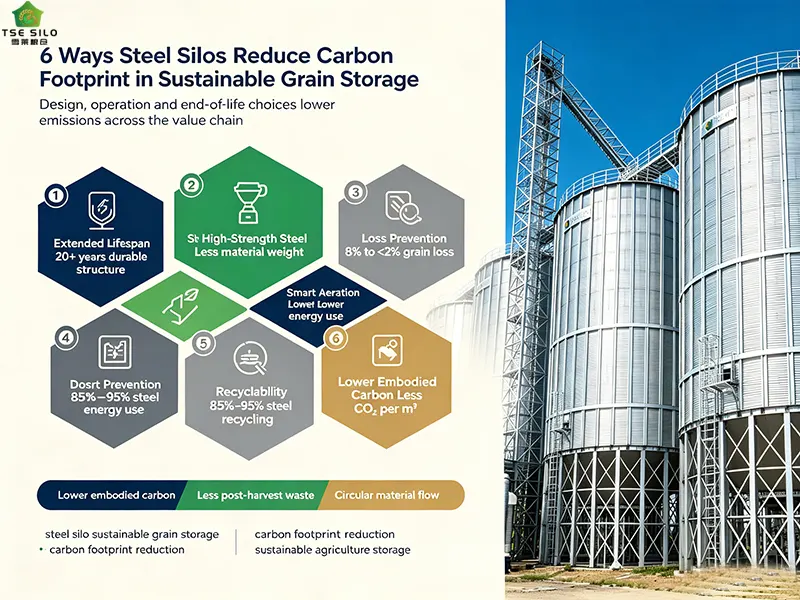
By choosing high-quality materials, adopting robust engineering standards, and embracing innovative coatings like ProMag, steel silos remain functional and safe for decades. This not only protects the economic value of stored grain but also contributes to more sustainable and resilient food and feed production systems.
In the context of global food demand, these advantages play a crucial role in meeting sustainability targets such as those outlined in the UN Sustainable Development Goals (SDGs). For millers, farmers, and grain traders, investing in steel silos is not just about protecting grain—it is about protecting the planet.
Every silo built is a long-term investment—for the client, for the food supply chain, and for the planet. As the global community works toward a lower-carbon future, steel silos stand as one of the most effective, proven, and accessible solutions for sustainable grain storage available today.
Written by
Shandong Shelley Grain Steel Silo Co., Ltd
Editor Jin
WhatsApp : +86-18653877118
Email : shelley@cnshelley.com